

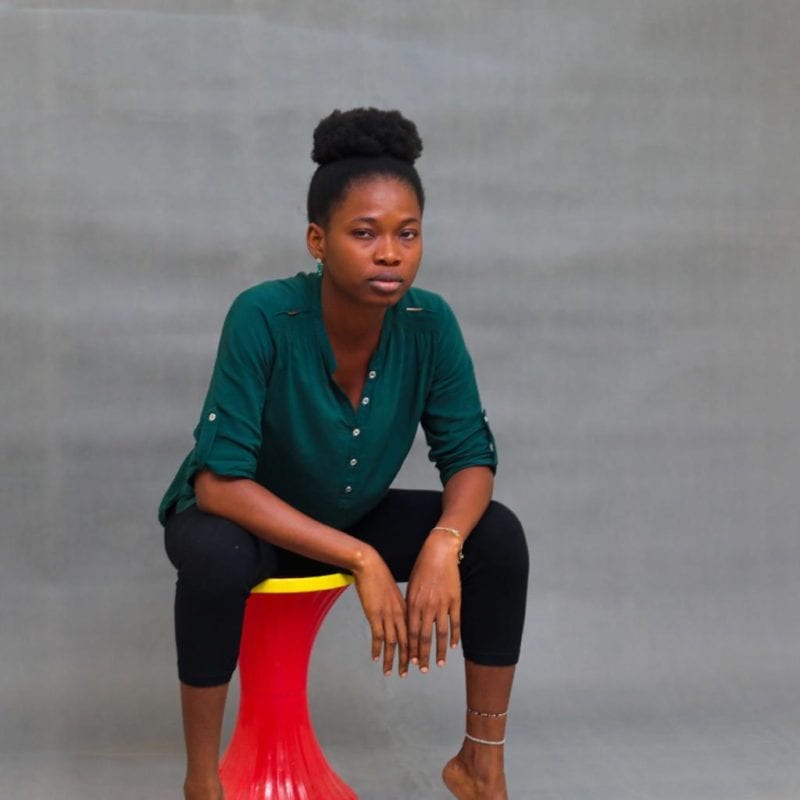
Author of two books and scriptwriter, Lois Burutu talks about her journey into what is now her career. She sheds some light on growing up in the Niger-Delta and how it influences her writing, among others in this virtual chat.
How did all of these start for you?
The first time I wrote anything at all, it was to immortalise someone. I had lost my sister, and I felt her memory had started to fade, so I decided to write something down so I would never forget her. That was the first thing close to creative writing I would do. It was a poem, and it was sometime in 2007.
I started writing more in SS1 after meeting some friends who wrote novels. They had collections that others in school then used to borrow and read. I was amazed by this and wanted to try my hands on it as well.
However, Lois Burutu did not know how to write prose fiction at that time. My type of writing at the time was more of drama.
So, I wrote one and showed it to one of the girls who made some corrections. One of the takeaways for me was to try to describe situations and not just say what people said. That was how I became a part of the novel-writing clique in class then. That, I would say, was the beginning of the creative writing part of me.
I remember one time my mum saw one of my stories and started crying after reading it. I really can’t remember what she saw then, but I understand why she felt that way because I write most of my stories like my own experiences.
Initially, I wasn’t an art person; I was more into science. But at some point, it was clear that was where I was headed, though my interest was specifically in Law.
So, I calculated the number of years I would spend in school studying law, and I felt by the time I would finish, Law may be the only thing I would say I’m knowledgeable about.
As a result, I decided to take a year out before getting into the university to learn something unrelated to Law. I chose scriptwriting (or, let me say it was recommended).
Next, there was an ad on TV, and I moved to Lagos to join Wale Adenuga’s PEFTI (The Pencil Film and Television Institute) for a scriptwriting course.
I finished the course and came back to go for my undergraduate program. Some things had happened in between that made me change my mind about studying Law, so I finally settled for English and Literary Studies at the Niger-Delta University, Bayelsa state.
After school, I returned to Lagos to pursue scriptwriting since I was now a graduate and stand a better chance of getting jobs.
Then I registered for Afrif (African International Film Festival), and I was selected to study Scriptwriting at La Cinefabrique, Lyon, France.
You said something about being a science person earlier, does that mean you were a science student in Secondary School?
My school did not separate Science students from Arts’. Everyone learnt everything together until, I think, the second term in SS3. I just knew that I did better in science subjects and paid more attention in science classes.
How old were you when you made that first attempt at writing you talked about earlier?
*checks diary*
It was in 2007, I was 14.
You’ve published two books – Gesiye and Ina. What influenced those two stories?

Ina is a prequel to Gesiye, though I wrote Gesiye first.
To answer your question, let me backtrack a little bit. One of my favourite science subjects is Geography. My dad is a hydrographer, so I had access to his geography books – books on astronomy and the rest. Then he had some history books too which explains why history is like my favourite Arts subject.
There is something about those two subjects (History and Geography) that link to patterns of lives lived by people in the past.
Now, Gesiye is my mum’s name, but the book is not totally her biography. What I tried to do with Gesiye is finding a balance between history and fiction.
My perception in storytelling is that the best stories are the ones we’ve lived. So, I often draw inspiration from actual experiences. I drew inspiration for Gesiye from my mother’s story and the stories of women she shared with me. Because we have this storytelling culture, she’d always tell me stories of different women, even in regular conversations. And all of it would come together to mean something when I sit to write Gesiye and Ina.
You grew up in South-South Nigeria, and the ‘single story’ most people have of the region have to do with oil, militancy and most recently, Goodluck Jonathan. How would you say growing up there influenced your writing, and are there some new perspectives about the region that you try to bring to the spotlight in your writing?
Yes, a great deal!
As I grow in writing, I’ve come to see that Literature is one way that we experience places. And my experience in France made me realise that people outside Nigeria are clueless about our geography and culture. They just feel there is Nigeria, and there is Lagos (because it’s popular). The next people they seem familiar with are the Igbos because of their history (Biafra war) and the export of stories through writers like Chinua Achebe, Chimamanda Adichie, among others.
Yes, South-south has produced great writers such as JP Clark, Gabriel Okara and the rest. However, I wanted to consciously tell a story that talked about the Ijaw people specifically, to explore the story beyond oil and militancy.
Those are our realities as they truly happened. But they only constitute a part of our story. There are other stories about us worth telling too.
Gesiye, for instance, is part history and fiction. Yet, when I made references to the ’50s and ’60s, I deliberately left out stories on oil exploration, politics, militancy as more than enough has been said about all that already.
My story focused more on other parts of our story that people barely know about, such as our culture, language and names. For instance, I have friends in the movie who call me to ask for Ijaw names as there are not so many books to check for this.
Which writer would you say has influenced your writing the most and why?

It’s hard for me because I’ve moved through different phases of writing with various influences, says Lois Burutu.
I started as a poet, moved on to writing drama because of Shakespeare’s influence. Then I moved on to write novels with influence from the Harley Quinn series and the rest.
But presently, since I’m more into scriptwriting, I tend to have more influence from other filmmakers like Shonda Rhimes.
Also Read: 10 Easy Ways to Improve Your Writing Skills
But for Nigerian writers, a writer I really love is the late Chinua Achebe. I like the tone of his narration.
I didn’t say Chimamanda because I knew Chinua Achebe’s writing first, which already influenced me. So, when I read Chimamanda’s books, I saw the Chinua Achebe’s influence there as well.
Lois Burutu, You got married recently, congratulations. How has that influenced your writing or creative process?
**laughs**
Maybe I will have an answer to that in a year. But right now, I feel the same. Sometimes, I wake up, and I think, “oh, I’m married”.
There is still that confusion of how to answer when people ask my name – do I say my father’s name or my husband’s name? So, I’m still adjusting to that.
Lois Burutu, It’s evident in your writing that you’re a feminist. Why did you think it was necessary for you to be a part of the movement?
I’m a feminist because I believe in the evolution that the conversations around it is causing. The world I’m experiencing today results from ugly conversations that were had before I was born. But they were necessitated and for my benefit.
They may not have had a name for it at the time, but it resulted in a better world that I enjoy. So, if I see lapses in society and there is a need for me to lend my voice so that the person ahead of me will enjoy a better future, then yes, I would lend my voice.
Are you working on anything at the moment?
I dabble between being a novelist and a scriptwriter. I write novels because of the challenges in the Nigerian film industry when it comes to production. As a freelance scriptwriter, I can’t just go and write some kind of story and start looking for who has money to produce them.
Having it in a novel like Stephen King books or the Harry Potter series makes it a document that will always be there. One day, I will have the money to produce and make it into a script or one day, someone with capital will approach me to sponsor the production.
For now, I have different titles I’m working on. TV series, cinema films, novels are all in the working.
What would you say are the challenges of creative writing in Nigeria?
We have a lot of story problems, but I’m glad to see a new crop of writers rising to the situation. Still, the challenge is finding production houses that would accept and produce fantastic stories.
So, most times, writers have to tone down their stories; write simple things that are achievable rather than going fantastic (Fast and Furious kind of fantastic, for instance).
In terms of novel writing, one issue is publishing. Thankfully, a lot of writers are now embracing self-publishing platforms such as Bambooks and Okadabooks. However, there is still a lot of work to be done.




Quick Summary
Prefer the short version? Here is a concise recap of the key ideas in this article.
Also Read: 5 Must-Read Marketing Books for Business Owners in 2021 I remember one time my mum saw one of my stories and started crying after reading it. But at some point, it was clear that was where I was headed, though my interest was specifically in Law. So, I calculated the number of years I would spend in school studying law, and I felt by the time I would finish, Law may be the only thing I would say I’m knowledgeable about. How would you say growing up there influenced your writing, and are there some new perspectives about.