Home Blog Page 13

Tech Startups in Nigeria : Watch Out For 2022

706

2021 was an important year for both venture capitalists and African digital startups. Reopening companies and returning to everyday life meant that people continued to practice routines they had developed during lockdowns. As a result of this shift in customer preferences, Africa had one of the world’s most dynamic technological industries.

As African tech continues to rise, it’s no surprise. In addition, the market is primed for a technological boom since the proportion of Africa’s young population is steadily increasing.

Selection of some tech startups in Nigeria fast-growing firms to watch out for in 2022 was generated from last year’s investment rounds.

  • Kippa

Kennedy Ekezie, Duke Ekezie, and Jephthah Uche returned to the drawing board after their last startup failed to uncover a business-worthy challenge in Nigeria. Afterward, the trio decided to embark on a market tour to learn more about the challenges faced by Nigeria’s microbusiness owners. They discovered a severe issue they could fix after their research journey — bookkeeping. This issue was addressed in February 2021 with the launch of Kippa, a simple-to-use financial management app for small-business owners. After just a few months of growth, Kippa attracted thousands of users and raised $3.2 million in pre-seed capital in 2021. The question of how much more it will increase in 2022 seems logical.

  • Releaf

Releaf, an agritech company founded in 2017 by Ikenna Nzewi and Uzoma Ayogu, aims to industrialize oil palm processing in Africa and increase production. The Kraken machine, developed by a mission-driven agritech business, was designed to speed up palm nut processing and reduce waste. Releaf also supports environmentally-friendly farming practices.

  • Safeboda

The two-wheel ride-hailing platform of this Ugandan firm was created in 2018 before launching a nifty app in 2019. Uganda and Nigeria now serve more than 1 million users with transportation, parcel delivery, food and grocery shopping, payments, savings, and other financial services. Approximately 25,000 drivers are working for the organization, and they’ve delivered over 40 million packages in the US and the UK.

  • TymeBank

Using a hybrid approach of digital banking and physical service centers, this tech startups in Nigeria   is accelerating financial inclusion. Pick n Pay and Boxer locations around the country have kiosks where customers can sign up for the service (more than 80%).

  • Twiga foods

Using technology to develop food supply chains and retail distribution networks across Africa, Twiga Foods has been doing so since 2014. This tech startups in Nigeria uses a mobile, cashless, B2B platform to link farmers and vendors. Nevertheless, it has been challenging to maintain the purity of the products acquired from Twiga’s smallholder farmers.

  • Wave

When it raised $200 million in Series a funding last year, this mobile money provider located in the United States and Senegal made headlines. The wave became the first unicorn in Francophone Africa with a valuation of $1.7 billion after this fundraising round.

In 2014, the two co-founders founded the company due to their dissatisfaction with the difficulties and high costs of sending money to Africa from North America. This tech startups in nigeria was founded in 2018 by the co-founders after selling Sendwave to WorldRemit in 2017. The two-year-old business claims to be Senegal’s leading mobile money player and more than half of the country’s adult customers.

  • Chooya

In the wake of prior tech startups in nigeria failures, Igwe Uguru founded Chooya, an e-commerce search engine that has since turned into Africa’s version of TikTok for e-commerce. Allowing customers to recommend and even be compensated for doing so is one of the unique features of Chooya’s platform.

When Chooya won the Entrepreneurship World Cup with a cash prize of $950,000, the market erupted. Since then, there has been impressive growth, with thousands of companies joining the platform. Founded in Aba, Nigeria, the Aba-based firm plans to expand to other African cities in 2022, starting with Nigeria.

  • Edukoya

Former Google Nigeria CEO Honey Ogundeyi started Edukoya in May 2021 after being fired. Edukoya includes many valuable functions geared specifically toward Nigerian secondary school students. A data-driven question bank with step-by-step solutions, a customized performance tracking system, and 24/7 test preparation and homework tutoring are just some of the features available. Within a few months of beta testing, 96% of students who used Edukoya performed better on their exams.

  • Minly

Creators throughout the Middle East and North Africa can use Mainly, an Egypt-based platform, to build genuine, personal relationships with their followers. The venue raised a seed round of $3.6 million last year.

From artists and musicians to social media stars and professional athletes like Egyptian footballer Mahmoud Trezeguet (who plays for Premier League club Aston Villa) Mainly has a devoted following of more than 50,000 users since its launch in 2020.

  • Payday

To “create PayPal for Africa,” Payday raised a pre-seed capital of $1 million in October 2021. It was the first Rwandan firm to be accepted into Techstars Toronto Accelerator Program in the same month.

Favour Ori, a Rwandan fintech, launched the service in 2021, and it’s helping Africans transfer and receive money around the world. Payday had more than 5,000 users in its first three weeks, most of whom were referred by friends and family—and handled $1.4 million in transactions.

  • TalentQL’s AltSchool

Many people in Africa are excited about learning digital skills, but there aren’t many places to understand them. That’s why in October of 2021, TalentQL opened AltSchool. AltSchool is an tech startups in Nigeria that will begin offering classes in April 2022 and is geared toward people who want to learn the basics of software engineering in preparation for a career in the field.

  • Stitch

Since its $4 million seed round in February 2021, Stitch has secured a $2 million seed extension to speed up development, launch its solution and enlarge its Nigerian workforce.

With the help of Stitch’s data solution, app developers can connect their apps to their users’ bank accounts, allowing them to share their transaction history and balances, validate their identities, and make payments directly from their apps. Amounts reaching millions of dollars in fees have been processed through Stitch since its introduction, with Chipper Cash, Paystack, Franc, Sanlam, Yoco, and Flexclub as some of its regular customers.

Steps to Start Affiliate Marketing in Nigeria

What exactly is affiliate marketing?

According to Wikipedia, affiliate marketing is a type of marketing focused on “performance.” It is a method for large organizations to recognize and compensate their affiliates for the marketing efforts to convince clients to purchase their products or services. On the other hand, affiliate marketing in Nigeria is a fantastic sales and marketing model that allows you to promote and market for e-commerce businesses while also earning commissions from your efforts.

What Is the Process of Affiliate Marketing in Nigeria?

As an example, if you want to sell a car, you will list it on an affiliate network in the hopes of finding an affiliate marketer who will sell it on my behalf for a percentage agreed upon by both myself and the web, which will act as the affiliate marketer. If you are an affiliate marketer, you can choose to market the car and have it sold using your affiliate link. A commission will be paid to you based on the agreement I reached with the network. You will still receive your money if you join my affiliate network and market the automobile directly, and you will receive it based on the percentage of sales that you generate that I have mentioned on the car.

The option of joining affiliate marketing in Nigeria instead of directly working with the product’s developer is the most secure alternative. The affiliate program could be shut down at any time by them. This does not necessarily imply that specific affiliate programmers are unsafe; on the contrary, it is scarce for this to occur in any one program.

Let’s take a closer look at the many components that make up successful affiliate marketing in Nigeria system in more detail.

  • The Merchant: (seller)

A manufacturer is a company in charge of the production of a particular product. Anyone can set up and run an affiliate marketing in Nigeria network, regardless of their background. All that is required to allow affiliates to sign up and promote items is the availability of a product to offer and the product’s availability to affiliate networks.

  • The Affiliate: (You)

The publisher is another term for this party. Aside from that, affiliates might range from a single individual to a large organization. This is where the marketing takes place. It is the responsibility of a companion to promote one or more affiliate products to attract and persuade potential customers to purchase the product in question.

  • The Consumer: (Buyer)

Customers, often known as consumers, are at the centre of the affiliate system. Without sales, there will be no commissions or revenues to be distributed; hence the situation is reversed. To reach the customer, the affiliate will utilize any means at their disposal, such as social media, digital billboards, or content marketing on a blog published on a search engine, among other methods of communication.

  • The Network: (Escrow)

A tiny fraction of affiliate marketers is concerned with the network. However, affiliate marketing in Nigeria networks, on the other hand, are essential to the success of any affiliate marketing strategy since they act as a link between affiliates and merchants. When it comes to marketing a product for safety reasons, companions may be forced to work through an affiliate network alternatively if a merchant (Seller) distributes their product through a single affiliate network.

In addition, the affiliate network serves as a repository for many different affiliate programmes from which an affiliate marketer can choose to promote their products.

Check Out The Top Startups In Nigeria 2022

In Nigerian affiliate marketing, there are several ways to get started:

Those who wish to go into affiliate marketing in Nigeria but aren’t sure where to start will find this guide to be of assistance. You can read it again and over again if you so desire. That’s the only way to ensure that it stays in your memory.

To get started with affiliate marketing in Nigeria, follow these steps:

  • Decide on a specific affiliate market.
  • Create a blog and post it on it
  • The third phase is to develop original material.
  • Affiliate programmers are a fantastic method to monetize your website’s traffic.
  • Make use of social media to get the word out about what you’ve written and published.

Step 1: Choose a topic for your affiliate marketing campaign.

When there is a lack of enthusiasm and passion in a business, a sense of fear prevails. Apart from that, affiliate marketing in Nigeria is a lucrative method of earning income. Selecting a specialization for your affiliate marketing in Nigeria or any other region of the world is critical to its success. In any case, it is dedicated to.

Understand that it can be challenging to choose a particular area of interest that you are interested in or that you are enthusiastic about. The good news is that there are a few strategies by which you might learn this information far more quickly than you might imagine. But first, let’s identify a market segment.

So, what exactly is a niche in this context?

For example, diabetic products could be considered a niche market in their own right. The health-related goods category has a significantly larger market share than other categories. Because diabetic products cater to a specific market segment, they have a smaller audience than general health and wellness products. Diabetic effects can also be beneficial to people striving to enhance their health.

For those of you who want to return to discover your affiliate marketing in Nigeria market, here are a few quick and straightforward methods to accomplish so:

Before committing to a specific niche, determine whether or not you will be able to monetize the market you are interested in economically.

  • What are some of your passions?

This is a straightforward way of determining your target audience. “What is the subject area that I am most interested in?” you should ask yourself. This could be a sporting event or something else entirely.

  • Is the niche well-served by affiliates in terms of traffic and sales?

Losing weight is a well-known and well-known niche, to name a few examples. It’s possible that you won’t be able to perform as well as you should because you’re new and don’t have much prior experience. So, if at all possible, seek out a less competitive alternative. It is preferable to have a giant fish in a small tank than to have a small fish in a large tank.

Step 2: The second step is to start a blog

You’ve researched the affiliate marketing in Nigeria industry and are ready to get started. The next step is to establish an affiliate marketing in Nigeria blog to aid in disseminating information about your programmers. Creating a blog for your affiliate business makes it feasible to generate recurring money from it. Even if you aren’t actively employed, a blog allows you to earn money from earlier work you have completed.

In comparison to previous generations, creating a blog is now simpler. You don’t even need to be familiar with coding to get started. Just make sure you’re dealing with WordPress instead of something else.

  • Selecting a Web Address for Your Organization

To get started, you first register a domain name for yourself. In most cases, the domain name you choose will serve as the basis for the name of your website. My own experience serves as a fantastic instance of what I am talking about. Effortlessly come up with a distinctive character; nevertheless, keep in mind that the first name that comes to mind may already be taken; therefore, come up with a couple of alternates.

  • Get your website’s web hosting and set it up properly.

In the same way that a domain name serves as your website’s address, hosting serves as the physical location where your website resides. The quality of your web hosting directly impacts the response time of your website when it is accessed via the internet. Because a subpar hosting company has the potential to cause downtime at any time, your website should always be hosted by a respected organization.

What is Business Education?

Step 3: The next step is to create an account on Blogger to begin posting on your blog.

Following that, you’ll need to start producing content for your blog, which you’ll do when you’ve completed the first setup. Guarantee you that the prospect of writing your first post can be scary but that it is always the most challenging step. Maintain a constant tone in your writing style throughout the document. When you write, you develop your writing abilities.

Conducting extensive studies will be necessary to develop high-quality material. If you want to be a successful blogger, you must be on the lookout for blogs related to your field. However, this does not indicate that you should copy and paste their content verbatim or risk receiving a Google penalty as a result. Even though you may not consider yourself a competent writer, you can hire a professional to complete your project. A well-written article can be purchased for as little as three to five bucks.

 In this particular instance, it could look something like this:

  • First and foremost, there are the reviews.

In general, reviews should not be fewer than a thousand words in length, and they should cover both the positive and negative aspects of the product or service under consideration. The product will benefit from your credibility as a reviewer, and your audience will be more informed about the product as a result of your review. The fact that you did not display any bias in your thinking will encourage people to return to your blog in the future.

  • Articles that teach “how-to” methods are number two.

It’s typical for “how-to” articles to detail how to complete or begin a specific task in a particular situation. For instance, the image you’re currently viewing is one such example. If you are well-versed in the subject area of your chosen expertise, you should find these to be valuable. In general, the greater the amount of visitors your blog receives, the more money you can generate from it, given that you have correctly monetized it.

  • The third category consists of articles with “Tips and Lists.”

Along with increasing traffic, you can write this piece even if you are a rookie at writing a blog. There is no need to be concerned if you are not a good writer or do not have sufficient knowledge of the topic you are interested in. Subscribe to blogs in your chosen field of expertise, and use the content of their posts as inspiration for your writing. Once again, resist the temptation to copy and paste a document. You will be tempted, but resist the urge to give in to the temptation.

Check the top 5 Ways to Take Your Marketing Strategy to a New Level

Step 4: Make Money from Your Content by Participating in Affiliate Programs.

On the other hand, a rushed project will arise if you skip phases 1–3 and jump straight to step 4. Because it will distinguish your organization from the competition, you must adhere to every procedure step.

  • Ads that appear within the text

Banner advertisements for the items and services you’re attempting to sell can be shown on your website. The majority of affiliate programmers provide their own set of banners for their affiliates to utilize to promote their products.

  • Contextual navigation relies on links to relevant content as a fundamental component.

Contextual links are frequently used for advertising affiliate offers by many people. Almost certainly, you came across a blog post that included a link to another website that provides items or services of interest to you. If a reader clicks on the link and makes a purchase, the blog owner who provided the affiliate link will receive a commission from the retailer.

  • Email marketing is a form of promotion.

A significant advantage will be gained if you have a mailing list of email subscribers. Consequently, you will quickly and easily create emails that incorporate links to affiliate deals. The amount of money you can make from their purchases is virtually limitless, provided they click on your affiliate links and complete the transaction on the merchant’s website.

  • Product Reviews and Evaluations

You can promote affiliate products on your website and increase traffic by publishing product reviews. Don’t create a biased assessment of a product or service because you want to earn a commission; instead, concentrate solely on the positive features of the product or service. Your readers will reduce your goals far more quickly if you write in this manner. People will not be discouraged from acquiring the product or service, though.

Step 5: get your site noticed!

No matter how new your blog is, you will not receive much traffic until you put forth some effort. The greater the number of visitors you receive, the more money you will earn. Keep this in mind while you’re advertising or promoting your website.

  • You can write a guest article with the assistance of other people.
  • Pay-per-click advertising (PPC)
  • Creating and sending out newsletters to subscribers

Conclusion

Affiliate marketing in Nigeria is not for the faint of heart, especially those just getting their feet wet in the industry. This business has the potential to convert your life from a source of anguish to one of profit if you employ the proper technique. With the aid of this tutorial, you will learn how to start affiliate marketing in Nigeria and turn it into a profitable venture. Join one of the most successful affiliate programmers in the country and increase traffic to your website through content optimization. Check to see that your affiliate links are evenly distributed throughout all of your marketing channels to maximize your return on investment (ROI).


Check Out The Top Startups In Nigeria 2022

Start-ups look to Nigeria, which has 208.8 million people and Africa’s fastest-growing economy, as an important location for launching their businesses. As a battleground for startups in Nigeria, Nigeria has emerged as a haven for those looking to expand and establish themselves as a long-term digital leader.

Additionally, it has seen a GDP growth of 6.9 percent, making it the largest economy in Africa primarily due to its vital oil and gas production.

These startups in Nigeria have risen to the occasion and accepted the responsibility of creating world-class businesses and being a part of Nigeria’s many platforms and businesses. Startups in Nigeria use new technologies and fix people’s problems to spread their business. Startups in the transportation, banking, hotel and investment sectors are making a huge impact.

In Nigeria, many new businesses are finding success by offering their products and services to many people. Some African entrepreneurs have expanded their services throughout the globe and established themselves as a global brand because of the region’s rapid development.

A list of 30+ startups in Nigeria to watch in 2022 has been compiled below.

Auto Check

These startups in Nigeria makes it easier for Nigerians to buy and sell cars. TLcom Capital and 4DX Ventures lead the $3.4 million funding round for this automotive technology business.

This firm’s goal is to provide a safe and secure car-buying and selling environment. To prolong the lifespan of your vehicle, Autocheck also offers repair and maintenance services in Nigeria.

If you’re looking for more than just a simple oil change and a new set of wiper blades, this is the place to go. You may download their app from the App Store and use it to upload your vehicle’s details, register it, and obtain a maintenance schedule.

Paystack

Paystack is Nigeria’s leading Fintech firm, and it’s expanding quickly. Paystack is currently primarily concerned with the processing of payments. Paystack makes it easier for retailers to accept payments from their customers. Two long-time friends started the company in 2015.

PiggyVest

Nigerians have embraced PiggyVest, a fast-growing Fintech startup. PiggyVest was once known as PiggyBank.ng before being renamed. With the software, Nigerians may save and invest money more conveniently. Download the app, register, and then saves or invest. It’s that simple!

Field Intelligence

Field Intelligence is promising startups in Nigeria with a lot of room to grow. It is their job to organize and distribute medical supplies. Many African countries have already taken advantage of their pharmaceutical supply chain services from Abuja, with the potential to expand to other continents. They launched a branch in Berlin, Germany, in 2018.

Youverify

Founded in Nigeria’s Lagos in 2013, Youverify is an Identity Verification startup. The startup’s access to numerous databases aids in the verification of identity. After launching in 2017, Standard Chartered, Sterling Bank, NIPOST, and Bolt have all cooperated with the company.

Carbon (PayLater)

Carbon is a rapidly expanding Nigerian Fintech business. Carbon’s primary goal is to give short-term loans to Nigerians without collateral through its mobile app. The startup just added an investment tool to its app. It is saving and earning interest for Nigerians. Carbon, formerly known as Pay later, changed its name.

Thrive Agric

Thrive Agric is a startup in agricultural technology that aids farmers in obtaining financing options. In addition to Sterling Bank and FCMB, many other companies are on this vast list of supporters.

Migo (KwikMoney)

Cloud-based platform Migo, formerly known as KwikMoney, provides unsecured loans to customers. Without a physical card, people can use Migo to purchase goods and withdraw cash. Migo was founded as Kwikmoney but has since changed its name. When it was known as Kwikmoney, they were one of the most famous startups in Nigeria.

Kobo360

When it comes to transporting goods, Kobo360 is a platform that simplifies the process for shippers, truckers, and cargo receivers alike. They rose to prominence after winning the MIT Solve Global Health Challenge in 2008. Kobo360 is one of Nigeria’s fastest-growing firms, thanks to its rapid rise in popularity in such a short period.

Eden

In Nigeria, this tech-enabled home concierge service is a one-of-a-kind startup. Maintaining your home and completing errands has never been easier, thanks to Eden! It takes care of your regular activities by appointing somebody to do them for you. This enables you to continue with your day-to-day activities as usual. It saves its consumers time and energy, and it is noted for its expertise.

Flutterwave

Through its APIs, Flutterwave makes it possible for its customers to create their payment systems. Custom payments can be built using this platform’s underlying technology, services, and infrastructure. Merchants, banks, and other financial institutions are among the company’s many customers. Since 2016, the business has handled approximately $8 billion in transactions.

Gradely

A startups in Nigeria called Gradely’s goal is to make learning more accessible to children. Each student’s learning gap is addressed early on by working with instructors, schools, and parents. In addition, they provide pupils with a personalized performance and learning path to follow. Real-time feedback is also provided. There is a catch-up component on Gradely where they design custom classes to aid students who have fallen behind.

Konga

Konga is a web-based retailer. From books to phones to food, it has it all. As an online shopping destination, Konga.com is well-known. As of 2012, it was just beginning to take off, but it’s now aiming to become the world’s largest commerce trading company. In this way, merchants and buyers can purchase large quantities of a given product.

Zinox Technologies has purchased Konga, a leading e-commerce platform. By providing a wide range of literature, healthcare, baby items, cell phones, laptops, and clothing, Konga.com aids customers in their personal development. For the past few years, Konga has provided excellent service to Nigerians, earning the company recognition as one of the top startups in Nigeria.

Opay

As a financial business that focuses on Africa, Opay develops a variety of goods that include payment processing, transportation, grocery delivery, and more. OPay is used by millions of individuals every day to transfer money and pay bills. VCs and Fintech companies are now based in Nigeria. They recently received a $120 million investment and obtained $50 million in private funding.

Otras

Otras is a learning tool for medical professionals that want to stay on top of their game. Orac’s goal is to create a learning platform that aids in the development of healthcare professionals. To now, they’ve helped a total of seventy-thousand dollars to support a variety of experts. Otras is regarded as one of the most excellent e-learning tools for African health practitioners because of these features.

ReQuid

ReQuid, startups in Nigeriathat lets you invest in agriculture, is an intriguing venture. This tool makes investing, managing and liquidating your investments easier. They’ve already racked up over a thousand users and are on track to become one of Nigeria’s most prominent firms.

Roqqu

Users can utilize their debit cards to purchase cryptocurrency through their mobile app or web platform. Users in Nigeria may securely exchange digital assets on this platform, which was built with them in mind. Bitcoin, TRON, and XRP can all be used to pay you on Roqqu.

Conclusion:

Nigeria has many start-ups that you should keep an eye on in 2022, so here they are: They all deserve to be on this list of the best startups in Nigeriain 2022 because they add so much value to the lives of Nigerians.

Also Read:

How to Pronounce Entrepreneur
What is Business Education?

5 Ways to Take Your Marketing Strategy to a New Level

Are you looking for ways to take your marketing strategy to a new level? If so, you’re in luck. Here are five different ways that you can improve your marketing efforts. Improving your marketing strategy can help you reach more customers and generate more revenue for your business:

Incorporate the Latest Trends in Your Marketing Strategy

Marketing is an ever-changing field, and there are always new strategies that you can try. These include everything from social media to email campaigns and more. You’ll want to stay up-to-date with what’s going on, so you don’t miss out on any opportunities! Be sure to research what other businesses are doing as well – many times. They’re ahead of the curve when it comes time for their marketing efforts.

Create a list of potential ideas based on those trends mentioned above. Look at how each one could benefit or hinder your company and prioritize them. Try out a couple of new strategies each month to see what works best for your business. Remember, not everything will be successful, so tracking analytics and revising when needed is essential. When incorporating the latest trends into your marketing strategy, always consider what’s best for your specific business. There are plenty of trendy ideas that might not work well for you – or worse, could hurt your business. So do your research before jumping on any bandwagons!

Create a Well-thought-out Content Strategy

Content marketing is one of the most powerful tools you have in your arsenal. It can help increase engagement, build trust with customers and prospects alike, and improve search engines’ SEO ranking. It’s important to take the time upfront to develop an effective strategy from scratch. Thus, there won’t be any wasted efforts later on, which could cost you even more money. One way would create buyer personas based on research conducted. Also, identifying what types of content would best fit their needs—or better yet, help solve problems they’re facing!

Build Relationships with Influencers

Influencer marketing has been popular in recent years. But it’s important to remember that not all influencers are created equal. Some will have more sway over your audience than others. This is because they’re more trusted and respected within their respective niches. That said if you want to build relationships with the right people, who can help get the word out about your business? Start by researching potential candidates. The best way of finding which one might be most appropriate would be to check each person’s profile page for links back to his/her website. They contain contact such as an email address listed there.

Once you’ve identified some people who are likely to influence your audience, send them an introductory message explaining what kind of business model works best with theirs. With this, they will understand why it would be beneficial to work together. Follow up on questions that may arise. Also, set clear expectations about compensation if applicable.

Experiment with Different Social Media Platforms

Social media is one of the most cost-effective ways to reach a large audience quickly. But that doesn’t mean you should stick with the same ones forever if you want your marketing strategy to stay up-to-date. It’s important to experiment with new platforms as they become available. Also, revisit some older ones that may have since changed in popularity. For example, Snapchat was once thought of as only for teenagers and young adults. But has now grown into a platform where businesses can share content with their followers. LinkedIn is another excellent example of an older social media site that’s seen recent growth among professionals. This is because of its ability to help build relationships between groups and discussion forums.

The key to success with social media is understanding that not every platform will be a good fit for your business and its target audience. So take the time to research each one before diving in headfirst.

Create a Loyalty Program

Loyalty programs are one of the most effective targeted marketing strategies for businesses. Why? Because they help to increase customer retention rates by offering rewards such as discounts or freebies if someone purchases more than once within a certain period. These types of programs can also encourage repeat purchases. This is because people like to showcase their benefits to their friends or family members who may not have heard about your business yet.

Final Thought

You don’t have to spend a fortune on marketing your business for it to succeed. Many ways can be done at little cost, and some of them even need no money. The key is finding out which one works best with what type of customer you’re trying to reach. Also, implement tactics based on those results over time until they become part of the everyday routine for both yourself and your employees.

Suggested Read: Differences Between Sales, Marketing and Business Development

NG CARES | What You Should Know

BACKGROUND

NG CARES,NG_CARES - Nigeria COVID-19 Action Recovery And Economic Stimulus

The NG CARES, Nigeria’s response to the effects of the COVID 19 pandemic on its citizens.

COVID-19 pandemic is a global health emergency with far-reaching consequences on the economy, basic services, social unrest and livelihood of the poor and vulnerable, worldwide. 

In Nigeria, the pandemic led to business failures and ultimately, the closure of many MSEs.

It left in its wake, loss of jobs, stalled provision of basic services in poor communities, etc. thereby increasing the number of Nigerians living below the poverty line.

Globally, many governments came up with respective initiatives and policies to try and make the change to the living conditions of their citizens.

In Nigeria, in line with the vision of the Federal Government of Nigeria to lift 100 million Nigerians out of poverty in ten years, the Federal Government of Nigeria, on behalf of the 36 states and the FCT, sought and obtained assistance from the World Bank to the tune of USD 750 Million for on-lending to the States and FCT to implement a two-year emergency response programme, named the Nigeria COVID-19 Action Recovery and Economic Stimulus (NG-CARES).  

Each State is allocated ex-ante USD 20 million, FCT $15 Million and the Federal CARES Support Unit is allocated USD 15 million.

The NG-CARES programme seeks to mitigate the impact of the COVID-19 crisis on the livelihoods of poor individuals, farmers, vulnerable households, communities and owners of micro and small enterprises.

The financial instrument is Programme for Result (PforR) at the states and FCT while the Federal level is financed through the Investment Project Financing (IPF).

NG CARES,NG_CARES - Nigeria COVID-19 Action Recovery And Economic Stimulus

NG-CARES leverages on past, successfully implemented government interventions such as Community and Social Development Project (CSDP), Government Enterprise and Empowerment Programme (GEEP), National Cash Transfer Programme (NCTP), National FADAMA Programme, State Employment and Expenditure for Results (SEEFOR) and Youth Employment and Social Support Operations (YESSO) without creating another project implementation structure.   

It is designed to support a budgeted programme of expenditures and interventions at the State level – targeting existing and emerging vulnerable and poor households, agricultural value chains, and Micro and Small Enterprises (MSEs) affected by the economic crisis.

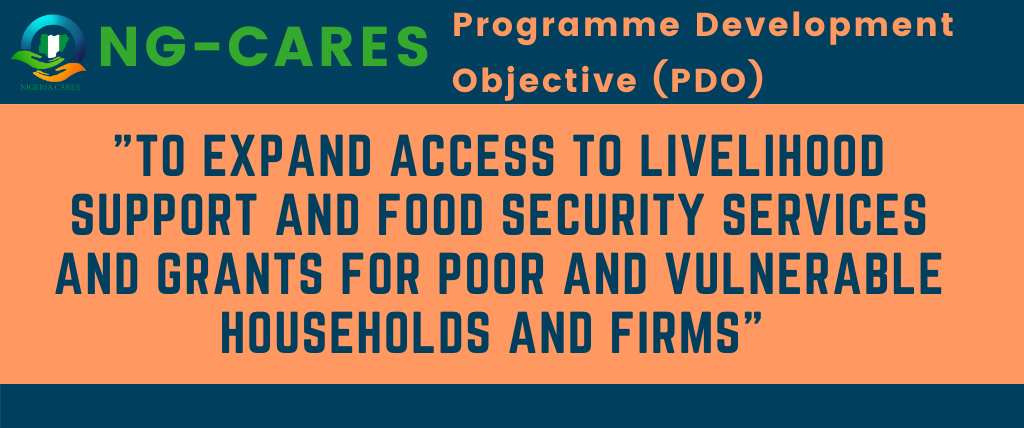
What is The Main Objective of the NG CARES

NG CARES
All you need to know on the NGCARES

What Are The Pillars of The NG CARES

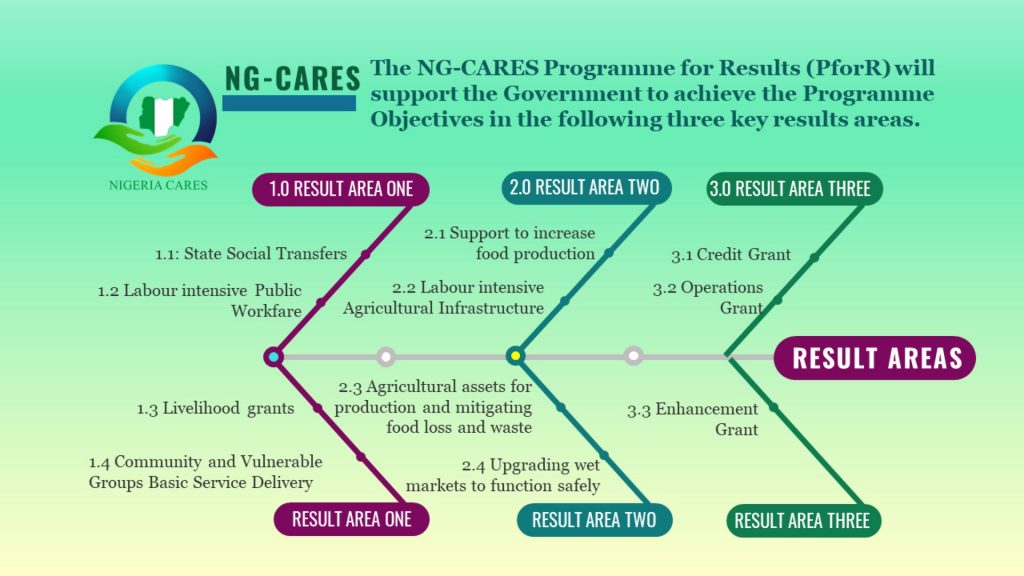
RESULTS AREAS

NG CARES,NG_CARES - Nigeria COVID-19 Action Recovery And Economic Stimulus

NG-CARES Programme is anchored on three (3) Result Areas with eleven (11) Disbursement Linked Indicators (DLIs) with options of selection by the States.

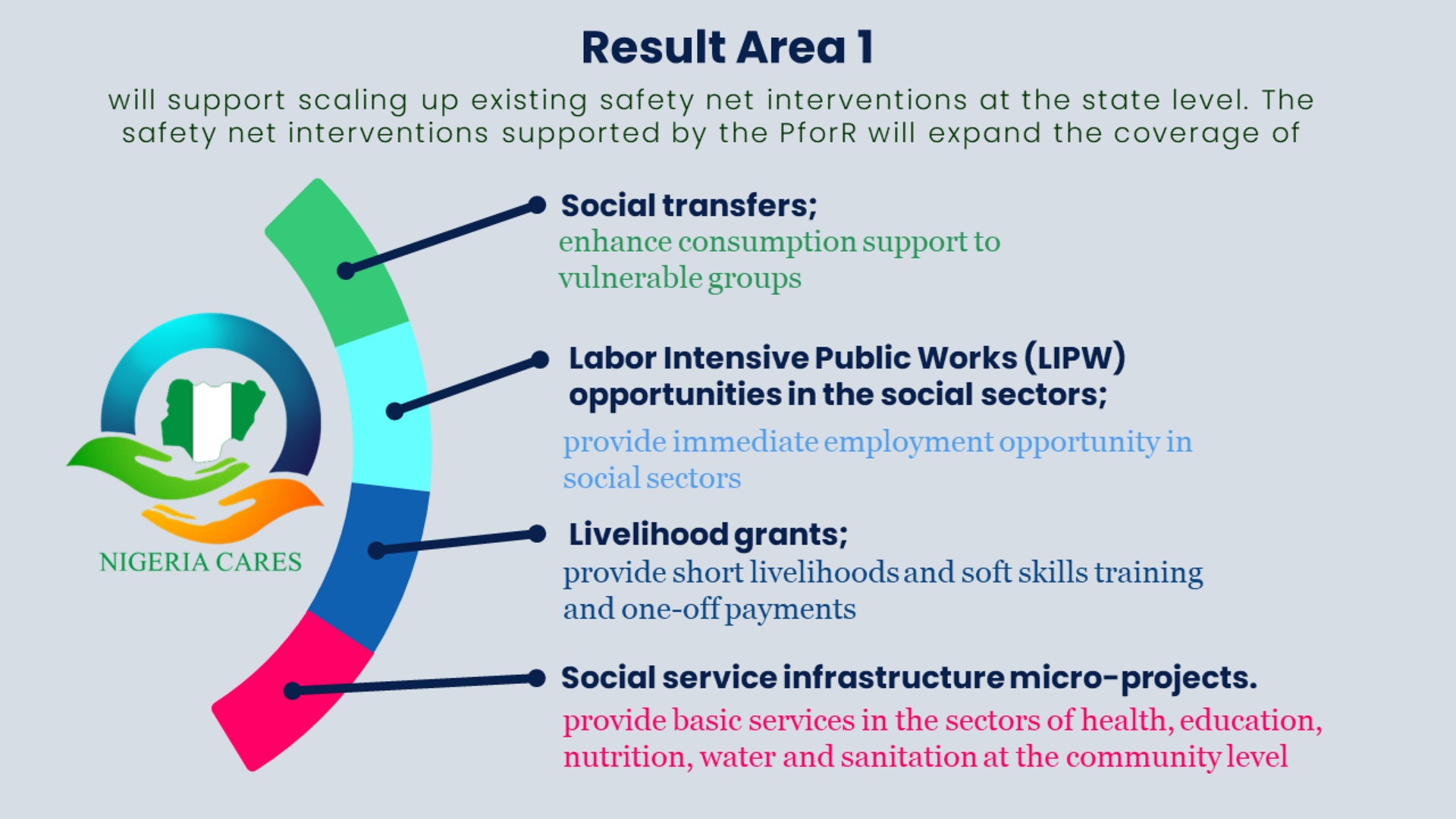
RESULTS AREA 1: Increased social transfers, basic services, and livelihood support to poor and vulnerable households. This involves:

  1. Social Transfer to aged, physically challenged, chronically ill and urban poor;
  2. Labour intensive public work activities;
  3. Livelihood grants to economically active household members;
  4. Community and group investment/basic infrastructure services.

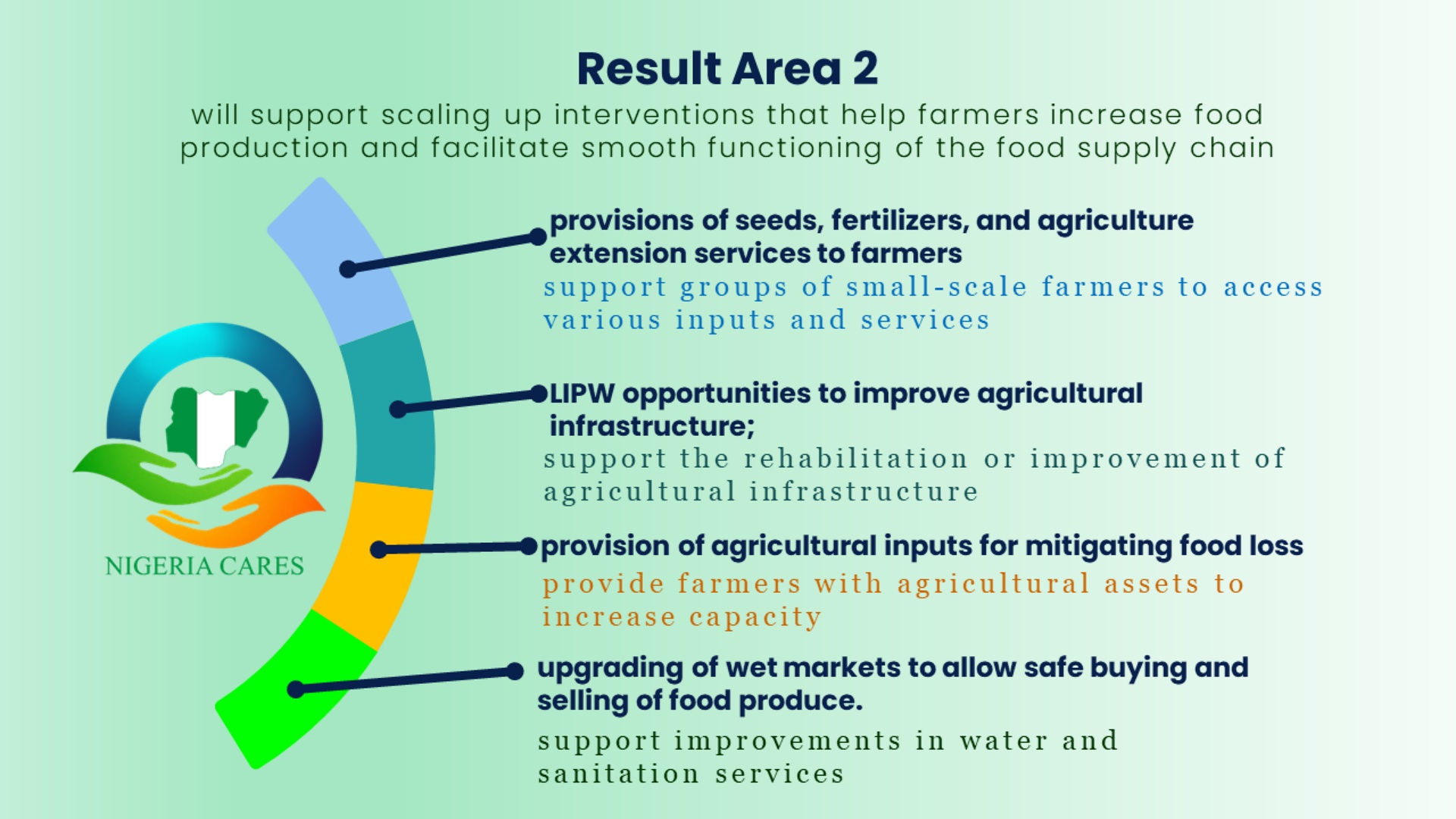
RESULTS AREA 2: Increasing food security and safe functioning of food supply chains for poor households. This is an agriculture-related activity that cut across the entire Agriculture value chain such as:

  1. Provision of agricultural inputs and services;
  2. Labour intensive agricultural infrastructures;
  3. Agricultural assets for production and mitigation of food loss and waste;
  4. Upgrading wet markets to function safely.
NG CARES,NG_CARES - Nigeria COVID-19 Action Recovery And Economic Stimulus

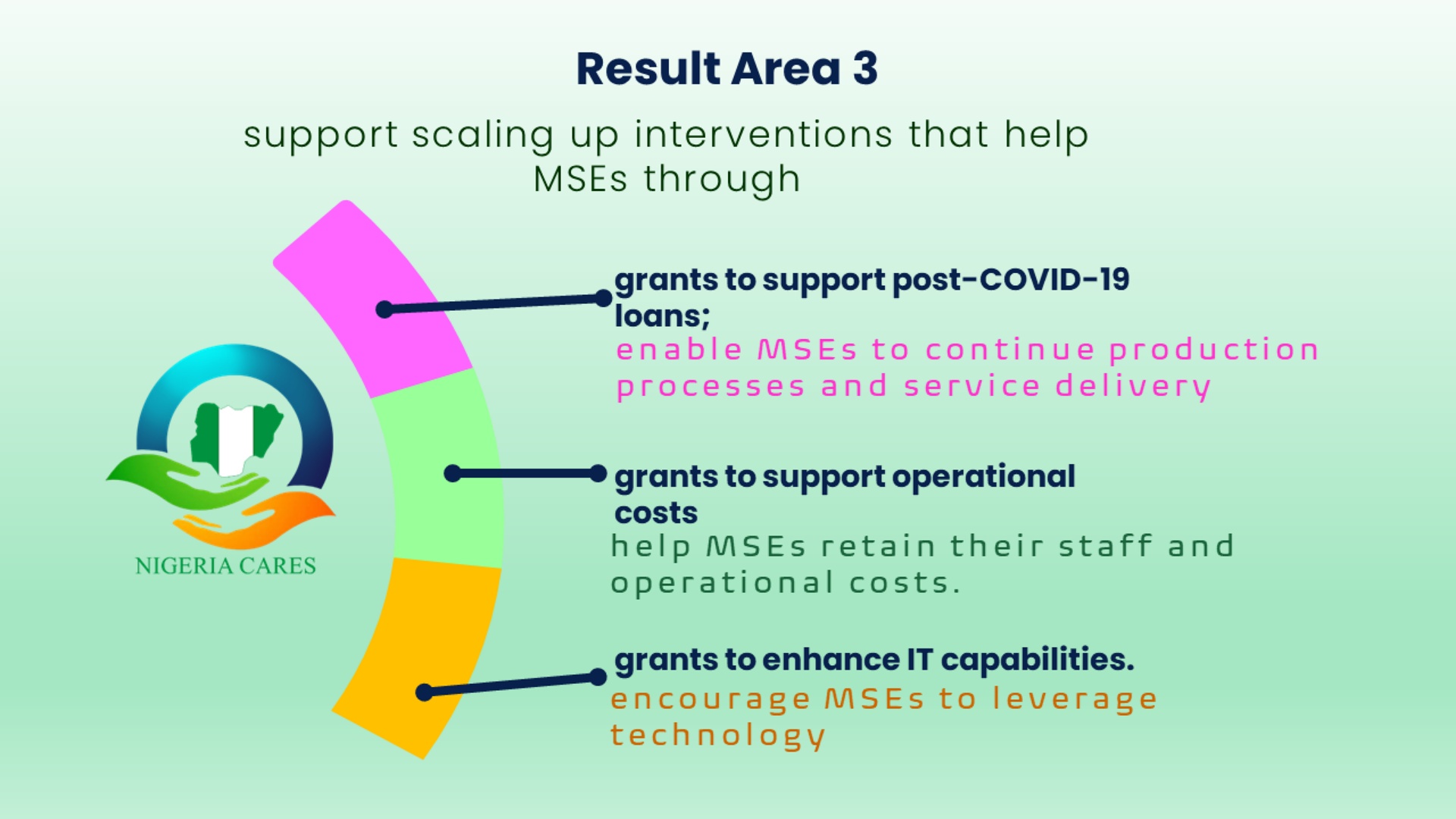
RESULTS AREA 3: Facilitating recovery and enhancing capabilities of MSEs

  1. Provision of well-targeted conditional grants, up to 40% to co-finance loans that eligible MSEs received during the COVID-19 pandemic crisis.
  2. Extending conditional grants to MSEs cover up to 50% portion of the monthly operation cost of MSEs.
  3. Support adoption of digital payments integration and IT connection cost of MSEs,

DISBURSEMENT LINKED INDICATORS (DLI):

Programme for Result (PforR) is a World Bank instrument for development that has been adopted to finance the implementation of the NG-CARES Programme at the State and FCT. The principle of PforR mainly focuses on results. Disbursement of funds in a PforR programme is directly linked to achievements of Results. States are reimbursed after the programme has been satisfactorily implemented and verified by an Independent Verification Agent(s). There are 11 DLIs under the NG CARES Programme.

NG CARES,NG_CARES - Nigeria COVID-19 Action Recovery And Economic Stimulus

DLIs FOR RESULTS AREA 1: Increased social transfers, basic services, and livelihood support to poor and vulnerable households. :

DLI 1.1           Number of beneficiaries engaged and deployed into Labour Intensive Public
Workfare (LIPW) activities in social services and receiving stipends

DLI 1. 2          Number of beneficiaries supported with Livelihood Grants

DLI 1.3           Number of beneficiaries supported with Livelihood Grants

DLI 1.4           Number of direct beneficiaries of completed and functional Community and Basic
Service Infrastructure microprojects.

DLI FOR RESULTS AREA 2:       Increasing food security and safe functioning of food supply chains for poor households.

DLI2.1            Number of farmers utilizing agricultural inputs and services from the Program.    

DLI2.2 Number of farmers accessing improved agricultural infrastructure

DLI2.3            Number of farmers utilizing agricultural assets (production and small-scale primary
processing) provided by the Program

DLI2.4:           Number of existing wet markets with upgraded water and sanitation service

NG CARES,NG_CARES - Nigeria COVID-19 Action Recovery And Economic Stimulus

DLIs FOR RESULTS AREA 3

DLI3.1 Number of firms receiving MSE Matching Grants to support new loans originated
after June 16, 2020

DLI3.2 Number of firms receiving Operational Support Grants

DLI3.3 Number of firms receiving IT Enhancement Grants

Anchored on the World Bank’s financing instrument of PforR, States can only get funding after the Independent Verification Agent visits which are once every six months followed by a No Objection (NOB) obtained from the World Bank.  The FCSU reimburses the States and FCT funds spent in implementing the verified project based on World Bank NOB.

As a PforR programme, Monitoring and Evaluation is key in the implementation. NG CARES is so designed that there are three levels of M&E.

The FCSU conducts routine M&E on the States and FCT, there is also the third-party Monitoring by Civil Society Group to undertake Beneficiary Assessment using Social Accountability and Citizens Engagement tools and visits by IVA to verify claims or results achieved by States. 

The IVA is a major component in NG CARES and it is responsible for preparing verification reports in line with the Verification  Protocol and certifying the achievements of the DLIs indicated to be verified.

How to Apply For NG CARES Stimulus Programme

Target Businesses:

a) Micro businesses (3 – 9 employees): this means that a micro business unit should have like 3 to 9 employees before they will granted access to the loan

b) Small businesses (10 – 50 employees): for small business unit they will need to boast of 10 to 50 employees.

Application Supporting documents:

  • 1) Proof of identification (NIN, Driver’s License, Voter’s Card, etc.)
  • 2) Proof of residence (Utility Bills, Voters Card)
  • 3) Proof of age (NIN, Voter’s Card, Driver’s License)
  • 4) Proof of Bank Verification Number (BVN Printout duly stamped by the Bank)
  • 5) that you have suffered financial set back
  • 6) you need to own any business for business categories

Key note:

  1. NG-Cares is a scheme of the federal and work bank
  2. It was established to help reduce the high level poverty and access to funds as a result of Covid-19 pandemic.
  3. About 750 million dollars has been made available by world Bank.
  4. Federal government will play a supervisory role.
  5. State are to implement the usage of the fund as they are the ones to locate those vulnerable people in the grass root.
  6. There is no central portal created for this scheme now.
  7. Individual state have their portal open for this purpose.

Related

How to Overcome Unique Challenges in Your Business

This article takes a deep look into how to overcome Unique Business Challenges faced by most small businesses.

Every business faces unique challenges. There is no “one size fits all” solution to overcoming these challenges. However, there are specific steps that you can take to increase your chances of success. This blog post will discuss some of the most common challenges faced by businesses and offer tips on how to overcome them:

Lack of Resources

Often businesses do not have enough money or time to invest in a good marketing campaign. This can make it hard for them to attract new customers and grow their business quickly as possible. One way around this problem is by using free tools like social media platforms, such as Facebook and Twitter. These platforms allow users to post content without spending much money at all. Another solution would be to outsource work overseas where labor costs are lower than here in America. So instead, we’re hiring someone from India who works remotely on our project while they live overseas.

Competition

Another unique challenge that businesses can face is a competitive market. It’s hard to stand out when so many other companies offer similar products and services like yours. If you want your business to succeed, you need to differentiate yourself from the competition by marketing yourself to attract customers who aren’t already buying elsewhere. Even better yet, create a new segment within the marketplace for them.

Related: Why Businesses Fail

Lack of Knowledge About where Best Advertise their Product and Service

Many businesses do not know how well their advertising campaigns will perform until they’ve launched them. This makes measuring difficult because if you can’t measure it, then there’s no way to know if what you’re doing is working or not. Luckily, though, some services offer insight into this problem by providing metrics on how well certain ads performed. Companies don’t waste their hard-earned dollars on failed campaigns without knowing whether those efforts will succeed.

Lack of an Online Presence

Many businesses lack a strong social media following. This can make it difficult for them to effectively market their products and services. One way around this issue is by creating content that appeals to people on Facebook, Instagram, Twitter other platforms. Also, consider enterprise technology services that can help you manage and grow your social media following. They will also help you interact with customers on a deeper level.

Poor Customer Service

Another common challenge faced by businesses is providing excellent customer service. This can be difficult because it takes time and effort to provide quality support that exceeds customers’ expectations. One way to overcome this obstacle is by hiring employees who are passionate about helping others—also, training them on how to provide the best possible service. Please make sure you have systems in place that will help you track any complaints or feedback from customers so you can address them.

Not Enough Time or Employees to Manage Everything

Businesses often feel overwhelmed because they have too much on their plate and not enough people to help them get it all done. One way to overcome this obstacle is by using systems like CRM software. They can automate tasks and make it easier for employees to track what needs to be done. Try setting realistic goals, so you’re not trying to do too much at once – this will only lead to frustration and burnout.

Unclear Vision or Goals

One of the biggest business challenges faced by most businesses is not having a clear vision or set of goals. Without these, it’s challenging to decide and stay on track when things get tough. If you find yourself in this situation, figure out what you want your business to achieve in the short-term and long term. Once you have a solid plan in place, make sure everyone involved with your company knows what it is to help you achieve those goals.

No Plan for the Future

Another unique business challenges faced by most is the lack of a future plan for their enterprise.

It’s essential to have a vision and set of goals, but it can also be helpful if you have some plan in place. This doesn’t mean having an idea about what your business will look like five years from now. It means figuring out how you’re going to get there one step at a time.

Poor Marketing Strategy

A good marketing strategy is essential for any business, and it can be a challenge to find one that works well. The key here is making sure your message resonates with customers. Also, have an effective way of getting them interested in what you have offered, such as through social media. Many companies struggle with finding someone who knows how best when it comes time for this task at hand.

Final Thought

By following these tips, you’ll give your business the best chance to overcome the unique business challenges that come with running a company. Remember, there is no single solution that will work for everyone. It’s important to find strategies that fit your specific situation and use them until they work.

What is Business Education?

Entrepreneurship training meets resistance at both managerial and employee levels despite the encouraging growth trends in recent years. Many questions arise from simple considerations: Were unrelated courses chosen? The business company requires that the business studies perform constantly be updated in its continuous development. It has various purposes to deal with the customers. Below you read about definition of what is business education.

Definition of business education

Business education must not only improve yourselves and develop your business, but Business education must also comply with market and customer requirements to provide better and different services.

Therefore, training improves business dynamics, strengthens relationships between team members, and is a tool for finding new market areas. Investing in people means seeing them as entrepreneurial wealth and a turning point in your business.

What are the benefits of studying business education?

Business education not only learns something new but Business education talks first and foremost about:

  1. Increase productivity

Workers who are more prepared in their field will learn the tools they need to perform their jobs more accurately and be more productive in managing and performing their jobs. In this case, the increase is standard if the exact mechanism applies to the whole company.

  1. Improve competitiveness

Weaknesses can be exploited after improving work procedures, customer relationships, and professional skills of each employee, fine-tuning the services provided, adding new ones, examining competition, sex, and disadvantages of acquiring a new one. Improve Customer stores and market.

  1. Improve the internal organization

Optimize all business processes, from attracting clients to project planning and presentations to being more flexible and flexible by developing soft skills, learning new time management dynamics, and specializing in your role. Remember all the functions, tasks, and procedures performed to get their work done most effectively and peacefully.

  1. To reach the goal

A well-oiled car will drive smoothly (or almost) to the finish line. This way, the company will achieve the desired results thanks to a better internal organization. A team that works in harmony with the dynamics of the mind.

  1. Employee motivation

Employees who are encouraged to learn and get the tools to improve will pay more efficiently and feel satisfied and valued and contribute positively to the business environment.

  1. Problem-solving and team spirit.

Which education should you choose? Planning and comparison are necessary for the proposed training to be functional, exciting, and inspiring for the person. It is essential to divide the decision-making process into two different paths to feel inspired by the expert’s perspective and from an individual perspective. Anything that enables a person’s professional growth or the position he occupies, to specialize and improve.

Overall competency development, including courses, in the team, to improve interpersonal skills, collaboration, work processes, time consumption, etc. These skills can be developed not only in face-to-face classes but also in the following ways:

o Gamification: learning through play. The game improves the ability to learn, works from the context you work in, and at the same time, you get instant feedback. In addition, the game works on the emotional and personal aspects.

o They not only strengthen teamwork but also help strengthen leadership and confidence.

How do you organize your business education?

You cannot wait to go and start a new course, plan a team or contact an external coach, but stop a bit. It would be best if you went step by step before exercising.

  1. Needs analysis

An essential starting point for investing in education. You need to understand the shortcomings, abilities, and requirements of your colleagues, business partners, yourself, and your company. Make sure you know your business goals and where you want to grow and improve. Repeat the same process as humans. This phase saves time and money, especially with collaborations, as you can later choose the right experience for each one.

  1. Training structure

Once you agree on your goals, you can decide which courses and experiences are best for them. Of course, this process must be carried out according to the budget provided by departments, individuals, and companies. Create a list of lessons by type, duration, price, and importance.

Once you have chosen, you may want to consider including it in your business plan or training program (if applicable) based on your company’s priorities and try to find a compromise.

  1. Check the project

Every quarter or every six months, depending on which course you choose, how advanced your training project is, whether the results you get align with your expectations and whether your goals have been achieved. So it would be best to analyse how you do it—inconvenience and so on.

Conclusion:

Now Business education has more information on developing training and organizing opportunities for you and your business, it’s time to plan! So it is clear what is business education. It helps to enhance your area and you’re dealing with a vast network.

How to Pronounce Entrepreneur

294

In this post, we’ve discussed how to break up the word “entrepreneur” into four syllables, as well as bonus recommendations from an expert on how to learn how to pronounce it correctly quickly.

In this post, we’ll show you how to correctly pronounce the word “entrepreneur” by breaking it down into its component syllables.

To help you pronounce Entrepreneur correctly, we’ve broken it into four syllables and explained how to do so.

English is a complex language. Even after years of study, many of us still have difficulty pronouncing some of the most familiar but difficult words. English has an odd quirk: it’s not always true that talks with the exact spelling also have the same pronunciation. That said, the word ENTREPRENEUR, comes from French, and it is really tough to pronounce.

How to Pronounce Entrepreneur is the subject of this article and how you can learn to say it correctly from experts. It is important to note that the actual pronunciation of the word “entrepreneur” has been explained in this article, which may vary depending on your regional dialects, tone of voice, and other factors.

How to Pronounce Entrepreneur in English?

The French term entreprendre, which means “to undertake,” is the root of the English word “entrepreneur.” An entrepreneur may be broken down into four distinct sections, and each syllable will be examined in detail to help you pronounce the word correctly.

How to Pronounce Entrepreneur?

By omitting the l from words like lawn or d from dawn, you can readily decipher the pronunciation of ‘en,’ which means “awn.”

How to Pronounce Entrepreneur in English?

Trah is how you say the word “tre.” Some people find it difficult to pronounce ‘the,’ but try to interpret it this way. Tré is composed of three consonants. When saying ‘tre’ as ‘truth,’ make sure your teeth are close together and your lips are flared. The ‘r’ sound in the word will be produced when your tongue pulls back from the top of your mouth.

Read: What is Office Procedure In Business Studies?

Phew!

How to Pronounce Entrepreneur correctly?

There are two ways to pronounce ‘pre.’ even though many people get confused and pronounce it as pre fro the prepare, this is a misunderstanding you must avoid. It is possible to pronounce the truth ruh as the ru sound in the word crus

nyow

How to Pronounce Entrepreneur in English?

A silent r is used to pronounce ‘neur,’ which is pronounced nyow. Aside from pronunciation rules, many people prefer to use your instead of the word’s correct pronunciation.

The question of how to say “entrepreneur” can be answered in this manner. Each sound should be combined and spoken as a single sound. As a result, awn+truh+pruh+nyow or awn+truh+pruh+neur is the correct pronunciation of the term “entrepreneur.”

To learn the correct pronunciation of words, consult Orthoepy.

How to Pronounce Entrepreneur in English?

A lot of people use the term “entrepreneur” nowadays.

Anyone who organizes, manages, and takes on the risks of their own business or venture is considered an entrepreneur.

The word’s root is entreprendre, which means taking up a French task.

To be successful in their entrepreneurial endeavors, many of the people I train to improve their American accent must be able to articulate this word clearly and correctly.

How to say “Entrepreneur” correctly – Additional Tips!

To assist you in your day-to-day quest to learn how to pronounce Entrepreneur correctly, our consultants have compiled the following list of suggestions:

  • Practice saying each word one time, then repeat the process several times.
  • Practice pronouncing in front of a mirror to see if you’re utilizing the correct mouth formations.
  • Be aware of what you say, and pay attention when you do.
  • Imitate the correct pronunciation by listening to the audio recording.
  • Learn to speak like the people you see in videos.
  • Pay attention to the intonation of your words.
  • The proper syllables should be stressed, so make sure you check!

Recommended Post: Entrepreneur Burnout, 7 Practical Ways to Avoid It

Conclusion

We hope that our guide to pronouncing Entrepreneur correctly was helpful to you. However, the tone and dialect of your voice and the acceptable forms of pronunciation in different places can significantly impact how you pronounce the word. We’ve already discussed and expounded on a commonly accepted pronunciation of the term “entrepreneur.” Take a look at the most recent articles about start-ups and entrepreneurship on Times Next.

Question:

Does Starting Your Own Business Make You An Entrepreneur?

Let’s have your thoughts on this question, please give it using the comment section below, who knows who may benefit a thing or two from your thoughts. Thanks

Entrepreneurial Development Process

An entrepreneur is a person who is willing to put in the time and effort to create something new and valuable while also taking on the financial risks and reaping the economic gains associated with it. The entrepreneur may or may not have invented this product, but they have added value. They have made practical and cost-effective use of available resources and abilities to accomplish this.

Anyone can learn to become an entrepreneur by going through an Entrepreneurial Development process, despite the widespread belief that entrepreneurs are born with essential talents.

What is the purpose of Entrepreneurial Development?

Structured training programs help entrepreneurs expand their business knowledge and abilities. In this field of study, business dynamics and its growth and expansion are examined. Entrepreneurial Development programs are designed to improve the skills and knowledge of current entrepreneurs and inspire others to follow in their footsteps.

Improved performance and increased corporate growth can be achieved via this development approach. As a result, the nation’s economy improves as well. More importantly, it allows entrepreneurs to handle the financial risks of running a business more effectively.

An economy’s unemployment problem is alleviated when the growth rate of entrepreneurial initiatives increases. As a result, stagnation is less of a problem, and the market is more competitive. An entrepreneur’s and their company’s ability to succeed is the goal of a procedure like this. Because of this, it promotes more people to become entrepreneurs and enhances entrepreneurial ambitions.

An Entrepreneurial Development program’s primary goals

Here are the goals of our Entrepreneurial Development program:

  • To cultivate entrepreneurial traits and behaviors in the next generation of leaders by providing them with the proper training and guidance.
  • As a means of finding the most promising new ventures and existing ones.
  • They provide inspiration and guidance to persons looking to establish their businesses or ventures. In this way, contributing to the economy is possible.
  • To educate the nation’s youth on the need for risk management.
  • Develop and implement various programs to promote entrepreneurship throughout rural areas and small towns.
  • Small business development and entrepreneurship can assist create jobs and self-employment.
  • To provide information on various government initiatives and taxes imposed on businesses (whether at the federal, state, or regional level)

Process of Starting a Business

Entrepreneurial Development growth is a multi-step process that begins with an idea. To construct a successful development program for individuals, here are the essential steps.

  • Find out more about the Concept for Your Business.

Entrepreneurial Development begins with this. Once an idea for a business has been conceived, the next step is for the creator to assess and identify the business’s potential opportunities. Because of this, they need to understand more about the company and its clients.

But it isn’t a simple one either. An entrepreneur must talk to their employees, the marketing team, the product design team, etc., to get essential information. Consumer surveys, on the other hand, often uncover numerous new facts.

  • An Exhaustive Analysis

Entrepreneurial Development must thoroughly assess a business idea or opportunity before moving forward. Entrepreneurs can do it on their own if they keep these things in mind:

  • Whether or not to put money into a particular option or concept.
  • What specifications must this product meet?
  • Based on the price, is it doable or not?
  • What are the company’s advantages in this market?
  • An investment must be made before the product or service can be used. And how to raise this money.
  • Whether or if it aligns with the company’s objectives
  • Entrepreneurs must also assess their abilities and see if they can handle such a project.

Plan of action for the company

To make the most of an opportunity, an entrepreneur must first recognize it and then acquire as much information as possible about it. This is a critical stage in the growth of an entrepreneur’s business. This kind of strategy serves as both a foundation and a yardstick for a business operation. It shows if the firm is on track or off course.

An entrepreneur must be committed to creating a business strategy because it takes time and effort. The critical components of a company plan, such as its vision, goal, objectives, funding, and the product itself, must be determined throughout this process.

Obtaining Materials

Locating financial and human resources is the next step in the entrepreneurial growth and management process once the business plan has been completed. Entrepreneurial Development can discover potential investors here. Additionally, employees are hired based on their qualifications and skills to perform various corporate functions.

Determining the Organizational Layout

It is a fundamental part of the Entrepreneurial Development. Once you’ve raised the necessary finances and hired the necessary staff, this is the final step. This chain of command makes it easy to resolve any issue.

The future of a firm must be considered after it is going smoothly. Entrepreneurs make their final decision about the course of their company’s development in this section of the program’s notes. To get a comprehensive picture of how the business is doing, it is essential to compare actual data supplied by the organization with expected data. An Entrepreneur Development will invest in expansion if everything is going well.

Individuals are assisted in developing their skills through training as part of Entrepreneurial Development process. In this way, it aids or even inspires people to establish new ventures or improve theirs already.

What is Office Procedure In Business Studies?

The way a company’s employees interact is determined by its protocols. A set of rules or policies often governs the daily operations of an office or small business. In the workplace, office procedure in business refers to a group of rules or guidelines that govern how the office operates.

Below you come to know what is office procedure in business studies.

Function

The efficiency of the workplace can only be maintained by adhering to proper office procedures in the business. Office procedures might include answering incoming and outgoing phone calls to paperwork, filing, taking messages, and even rearranging furniture.

Benefits

Office practices are implemented to maintain a consistent, efficient, and professional work environment.

Effects

It’s not uncommon for office processes to be aligned with company policy. No liquid may be allowed near computers, for example, according to business policy. Employees may be required to follow a protocol in the break room, such as consuming water or soft drinks safely away from computers under this policy. Staff that disobeys it risk losing their jobs.

The official procedure must be followed for the letter.

  • It makes daily office tasks go more smoothly and helps resolve structural issues.
  • It speeds up the completion of tasks.
  • Fraud is less likely to occur as a result of its implementation.
  • In general, it helps to keep the organization’s various departments in sync.

Procedure For Preparing Bills (Invoice And Receipts)

There are plenty of automated techniques that can be used to accelerate the generation of bills or invoices:

  1. The Computer

An electronic device that accepts, processes, stores, and retrieves data or information is a computer. The software can be placed on a computer to simplify creating bills, receipts, and invoices.

  1. The Typewriter

A regular typewriter can be used to swiftly, clearly, and uniformly prepare bills.

  1. The Typewriter/Calculator Fusion

The billing staff can type the textual data into the typewriter or calculator and then use special computation keys to determine the totals.

The Adding Machine:

Businesses that provide fixed bills to constant customers may employ ten-key or complete bank bookkeeping devices. An example is a bill for a service, such as electricity or rent.

Cash Register

The cash register is critical for adding machines equipped with a cash drawer. It enlarges the figures and prints them on tape. A cash register can be reconfigured to function as a billing machine.

The Photocopy Strategy

Like pharmacists and physicians, many small officers produce monthly bills and statements of account simply by photocopying the client’s billing card, which is then folded and mailed to the client in an envelope.

Procedures For Making Payments

Payment for items sold or services rendered in business can be made in various methods, including cash, check, or bank draft.

By Cash

Paper currency is a legal tender used to make cash payments in commercial operations. People exchange cash for goods and services, including books, magazines, food, and utilities. Money is primarily utilized for modest purchases.

By Cheque

A cheque is a legal document to a bank to pay a specified amount of money in a specified currency on demand. It typically bears the individual’s name to whom it is to be paid. Cheques are used to withdraw funds from a current account.

A cheque may be made payable to the individual and collected from either the bank, or it may be made payable to another individual inside the company.

By Bank Draft

A bank draft is similar to a cheque that the payee can cash over the counter. Because it is a cheque drawn from the bank, it is usually paid when submitted at the bank. The draft can be employed when a producer or merchant deals with wholesale for the first time or when giving payment abroad.

Through Bank Transfer

This is yet another bank approach that enables the transfer of funds from one individual to another via the bank.

To initiate a bank transfer, the person wishing to transfer money to another bank visits the bank where the money recipient has an account and fills out a form with the bank teller that includes the date, the name of the bank to which payment is to be made, the account number, and the receiver’s name. He then pays the money into the bank. The bank deposits the funds into the recipients’ bank account.

Conclusion

New employees are frequently given written instructions on doing various office tasks. Rarely do they catch you off guard. Employees can better prioritize their daily activities when familiar with office procedures in business and include them in their job descriptions. Hope from above you get answer of what is office procedure in business studies.