Every start-up is as strong as its weakest link. This old saying is particularly true about the impact of teamwork to a start-up.
You can have a great idea and work out a formidable marketing plan but the overall success of every start-up is in the strength of its team.
How Can You Build a Great Team?
It begins with the leader.
“Talent wins’ games, but teamwork and intelligence win championships.” -Michael Jordan.
Resist the urge to be self-reliant. Many leaders unconsciously try to control everything and, in a way, they create a counterproductive environment that deters team spirit.
Not often is the saying through that: “If you want something done right, you must do it yourself.”
Employees commit more to a team when they feel they are part of something way bigger. Make them feel like a part of the dream. No, make them a part of the dream and they’ll commit to it.
Humans can function at individual levels, but with adequate teamwork, productivity can be multiplied.
Yet if you’ve ever worked with someone that slowed down your effort, then you’d understand that teamwork isn’t natural; it is a skill that can be developed.
Humans by nature are emotional beings. This attribute makes our psychological composition more complex than machine intelligence. Yet, like Machines, humans can be reprogrammed and with sufficient exercise of our social skills, we can operate at optimal levels, for effective teamwork.
Building a Team Spirit
When working with a group, often times the problem isn’t about the task but about synergy.
Encourage team members to build social interactions, in other to enable them understand their colleagues and create empathy for one another.
When people understand themselves, they work better.
Skills That Enable Teamwork
The key to the success of a start-up team is trust. Can you trust your colleague to do their part diligently or?
1. Communication
Open and clear channels of communication ensures that no one is left out of the workflow.
It has also been discovered that neutral grounds help boost a healthy work environment. Too much formalities in office communication can great communication gap especially in modern work environment where there is a fusion of various generations: GenZ, X, and millennials all in same work space with baby boomers.
Ageism is real and if not checked it festers and destroys teams.
2. Empathy
The greatest deterrent to teamwork is selfish interest. When one member tries to outshine others or when one member is self-absorbed and obnoxious and becomes a burden on the members of the team.
Encourage teams to engage in other social activities outside work. Birthdays, and holidays are moments that encourage team members to bond.
We tend to empathize with people we know. Yes, you can have empathy for strangers too but this is different for team members that become more than team.
SEE video for team bonding games.
3. Agreement
There’s an old saying among Christians that two cannot work together except they agree. It is as simple as that; productivity increases when team members can easily reach an agreement over decision making process.
Blind agreement often points to a problem. If team members constantly differ to a single person’s opinion it often means they
4. Structure
Often start-ups struggle with maintaining a structure. I have learnt from experience, and I can authoritatively say that it’s better to structure your business from the scratch even if there are only two staffs because as the business grows, it follows the imprinted structure. Accountability, Priority, Leadership is essential part of the structure of any start up.
Team members should be encouraged to prioritize the company’s work ethic and values and should be accountable to leadership over every little details. As your start-up grows and new staff come onboard, you’ll begin to see the impact of structure to the team.
The World Health Organization (WHO) defines health as a “state of complete physical, mental and social well-being and not merely the absence of disease or infirmity.”
One of the three aspects of health, according to this definition by WHO, is “mental well-being”. Emotional Intelligence is an integral part of mental health, which, unfortunately, often gets left out in conversations about health. Many people focus only on the physical aspect of health, leaving out the mental and social well-being, especially in this part of the world.
As an entrepreneur who gets to deal with many people, emotional intelligence is a must-have skill. That is, for entrepreneurs who want to be successful.
But what exactly can emotional intelligence do for you as an entrepreneur?
1. It will help you identify customer needs more effectively
Getting inside your customer’s head and know what they need is a lot more complex than you think. You can make assumptions; that’s quite easy. But assumptions can be misleading and dangerous.
Therefore, direct communication with customers and data has been proven to be the best ways to identify customer needs. In other words, you need to be able to empathise with your customers to see how to improve your product to serve their needs better. Similarly, it will also help you discover new ways of marketing to your audience more effectively.
2. You will become a more effective communicator
It’s challenging to hold a deep conversation with people if you can’t empathise with them. If you can’t relate to others’ emotions, communication becomes less effective and more complex.
As an entrepreneur who always has to talk to employees, investors and clients/customers, you need a high level of emotional intelligence to see things from their perspective. With this, you’d be able to build strong relationships with all stakeholders and win people over.
3. Emotional Intelligence will help you unify your team through enhanced leadership
Even if you’re just starting your business, you should already be thinking ahead to when you’d have built a team that works with you.
Emotionally intelligent leaders get the best out of their employees. It’s the foundation for cultivating a unified vision, respect, and good morale, which results in improved productivity. Specifically, this is important for entrepreneurs who have employees working from home.
Emotional intelligence is vital for leaders who want productive employees.
4. You Improve your self-awareness
Knowing your emotional stand can be very useful to you as an entrepreneur. Your ability to identify and harmlessly express your emotions serves as a buffer against you having emotions that run wild and distort your perception. Hence, when you improve your emotional intelligence, you are able to make better decisions.
5. Better control over emotions
Entrepreneurship is not a child’s play. You would be faced with several roadblocks on your path to success. Therefore, as an entrepreneur, you will have to handle everything, from demanding clients, angry customers to difficult conversations and disappointing launches.
You may not have control over everything that happens, but with high emotional intelligence, you can get better at understanding your emotions in challenging situations without trying to suppress them or going off at a wrong time.
Also, the ability to control your emotions is crucial when relating with investors and other essential business stakeholders.
For instance, a team of co-founders learnt this the hard way when one of them got a heated debate with an investor. The investor then then started lobbying for him to be fired. And to solve the problem, the investor said there was only one way:
“You need to talk to a coach to work on your emotional intelligence.”
How to improve your emotional intelligence
Now that you’ve seen the importance of emotional intelligence to you as an entrepreneur, how do you go about becoming more emotionally intelligent?
Unfortunately, there is no quick-fix for it. We are talking emotions here so some work and learning has to take place. These steps below are a good place to start:
In your everyday conversations with friends, colleagues, and family, try to practice empathy. Pay attention to what they are saying, and try to understand what they might be feeling and thinking. Most times, we want the conversation to go in a specific direction, instead of actually listening and responding with empathy.
3. Talk to a coach or counselor
The above two are things you can do one your own or with people around you. However, it gets to a point when you need to talk to a professional. This is usually because you are either unable to practice on your own and you may need the help of a counselor to assess your progress.
A counselor or coach can as they’ll be able to regularly assess how you are doing and give you benchmarks. Feel free to ask for help when you need it as the process is not always easy.
Have you ever thought of business opportunities in cryptocurrency in Nigeria?
Despite the CBN ban preventing local banks from associating with cryptocurrency, digital currency remains widespread in Nigeria. In fact, the ban may have even increased the popularity.
As a result, presents potential business opportunities in cryptocurrency for those who are interested.
Here is a list of the top 5 cryptocurrency business opportunities in 2021:
1. Start a Cryptocurrency exchange
Starting your crypto exchange platform is arguably the biggest cryptocurrency business in 2021 (maybe second to having your own crypto coin).
An exchange platform is a website where people can sell and buy cryptocurrencies securely. To put this together, you have to be very familiar with how digital currency operates. Here are some popular crypto exchange – Coinbase, Luno, Binance, LocalBitcoins and so on. Yours too can join the list.
You will make revenues from charges on withdrawals, deposits and transfers, which would depend on the transaction amount.
2. Cryptocurrency Crowdfunding (IEO, ICO, STO)
A quick way to make money from crypto is through the crowdfunding strategy. The way it works is – you get investors to provide funds for your whitepaper, which has to be valid.
Crypto crowdfunding is of three types – IEO, ICO and STO.
ICO refers to the Initial Coin Offering, and it’s the website for many people to raise funds by presenting their projects.
IEO means the Initial Exchange Offering, and it implies that the projects would be verified to avoid fake schemes. While STO is the Security Token Offering, meaning only the tokens supported by the securities is allowed.
So, you can work with any of the three crowdfunding strategies to begin your cryptocurrency business in Nigeria.
3. Cryptocurrency lending
Cryptocurrency lending is the most exciting crypto business. If you understand how crypto works and have a regular flow of cryptos from different sources, you can start a crypto lending business with a specific interest rate.
Cryptocurrency is currently used in different ways in the global market, including payment, as a token, exchange or investment. It has wide use cases worldwide, and like regular money, people will soon start having needs to borrow.
4. Cryptocurrency escrow business
Starting a cryptocurrency escrow business is the finest and oldest business idea in the cryptocurrency industry. It lets crypto users exchange coins among themselves using an escrow admin. In this case, the escrow admin will handle the crypto transactions.
To prevent hacking and scams in this system, a personal key will be generated for each transaction.
5. Cryptocurrency MLM Business
Cryptocurrency MLM refers to the multi-level marketing business in the crypto world. It’s a good crypto business for entrepreneurs and startups. There are currently several MLM businesses in the global crypto market.
To start this business, you must find a way to get potential your potential customers to trust you. You can work with social media influencers and run some PR campaigns to earn this trust. Also, don’t forget to share testimonials of satisfied customers so they can inspire others.
In Conclusion
Cryptocurrency will only continue to grow as many have said it’s the future of currency. By starting any of these crypto businesses, who knows, you might be the Union Bank of the future. By the way, what do you knoow about artificial intelligence?
It’s the first step to gaining visibility. As usual, the first thing that comes to mind is a business name and logo and every physical object that can be associated with a brand.
The goal of branding is to create an image in the mind of its audience. It relies on the mechanics of human psychology and how it forms memories through sensory perception.
The key to creating a formidable brand for your business lies in understanding the buyer psychology of your ideal client.
Why Branding Is Important
Branding helps your business stand out from competitors. It also helps keep customers loyal. You may ask how? Well, people don’t like change and this Havard paper states at least ten reasons why people resist change.
When customers get used to a particular colour and pattern for a product, they are likely to stay loyal, especially when the competition is different. For example, liquid dish soaps have been lemon green for a long time in the Nigerian market; it’s a standard. When mama lemon was introduced to the market, they made their green slightly brighter than morning fresh. Unilever created the soap brand called Sunlight and branded the colour yellow along with a sweet floral scent. When they created a line of dish washing soap, it came in yellow as well. However the yellow liquid was some tones different from the yellow pack of it’s detergent brand. Despite its audacious change in colour trend, Sunlight was quickly received because of its track record, and also, the tone of the yellow still fit in the lemon family.
Somehow lemon works on the buyer psychology of an average dish soap user. I once saw a pink dish soap — well, no, thank you!
Let’s talk of branding for startups.
Learn how this T-short store brands as a food themed bakery.
What’s Your Product?
Think of your product beyond its physical identity. Why did you make the product? Was it to bring comfort? To serve as an alternative product? Or simply for style and aesthetics? Always start with why?
Even if you’re selling a hair product, understand that the real product is identity, it’s confidence, it’s style. When people go out to look for a solution to tough hair, what they really want is a product that restores their confidence to tough hair issues.
Studying your competitors helps you to understand your market, its challenges and how the competition has approached it. Above all, you find holes within the market that you can leverage while building your brand.
Who is your audience?
Study your audience. Listen to them talk. Don’t try to sway their opinion. Conduct small surveys and listen to their complaints about similar brands.
What’s Your Story?
A story doesn’t have to be complex to leave an impact. Like I always say, the best stories are the ones we’ve lived. Humans have one superpower; they can detect life. If it’s true, they’ll know. If it’s a sales trick, they’ll know, and they won’t like it.
A cheap story for the sole aim of sales is like a wifi signal with no internet.
Picking a Name and Logo
A brand with a story will win any day. A story told creatively will win every time.
Blend all we’ve discussed, let it reflect in your design, and you are sure to have a memorable business brand.
Finally, let your product experience reflect what your brand promises.
When people search online, Google’s search algorithm filters the result using artificial intelligence to determine the purpose of the search.
For example, when someone types
Ladies shoes
Or
Phones in Nigeria
The query is categorised as shopping interest. However, Google understands that there are different stages before an individual chooses to buy a product.
According to the above sample search query, google will prioritise images and businesses on the search page because it knows that they are either looking out for inspiration in pictures or buying a similar product.
Turn on Location
Location is key for every business. When people identify a need, the next question is often, “where can I find it?”
Most likely, people are finding it hard to find your business; this invariably affects sales.
The beauty of turning on your location online is that it helps you reach your ideal clients.
Google prompts buyers to find stores closest to them first as convenience is top priority for modern shoppers.
My Business Is On Google, How Can I Manage It?
Google map collects street data, and if you have visible signage or are in a location often visited by cabs and other map users, then Google may already have you listed by default.
That’s not enough.
Often an unmanaged page lacks proper information, so when people see your page on search results they won’t click on it because they probably can’t reach you. This affects your page ranking.
How to Sign Up?
I have a business page on Google for my freelance script writing company — The Synopsis.
I saw a video about the new innovations and I decided to try it.
Although I didn’t have a physical space nor did I require my clients to walk into my office to buy my product. I was one of the first to use the service for my line of business, and for a long time, I ranked high among film production companies in Lagos.
I hardly do much on it, but on a good day, I get pretty high traffic and google sends me a mail to remind me to update my information based on what clients may need around specific periods like Covid19 and during holidays.
Visit Google my business to either claim an existing page or add your page to the map.
After a 30day period, Google will send a letter to your listed address to confirm location, and within one week from the notice, your page goes live.
Other Benefits
Google my business improves interactions with your customers.
Have you ever left a location, and chrome notifies you to provide information about a business or rate it?
You don’t have to employ additional resources to check how well your business is fairing. Google does it for you.
Owning a business has its perks maintaining business growth isn’t easy even for startups. Who am I telling? You already know this, and that’s why you’re here.
Everyone wants to be seen, and so do startups, from relentless ads on every channel to bridge on privacy on smart devices by third-party apps hoping to drop in on private conversations searching for the next keyword to sell to advertising agents.
Yet 92% of people trust referral marketing more than any other form of marketing strategy.
The keyword is trust; people trust their friends and family.
The easiest and cheapest way to gain visibility for your startup is to get 92% of your customers actively campaigning for you or imitate the principles of referral marketing and retain 92% of customers that reach out to you for service.
How can you get your ideal customers to trust you enough to meet their needs?
Big brands are brutal when it comes to visibility, they fight to be the first on peoples’ mind when they think about a product, but startups don’t have that luxury. Startups have to rely on trust, which is what referral marketing offers.
People do not care about your product until they know you care about the problem they need to resolve.
Marketing strategies for startups
Whether you use social media or traditional media for your advertising, these strategies will help you grow your brand’s visibility by imitating the principles in referral marketing.
Answer questions
One way to grow your brand’s visibility is by generating content on social media that answer your audience’s questions.
What kind of questions does your audience ask before deciding to buy your product? These are called buyer intent questions. They reveal the intent of your ideal client. If you can generate contents consistently that answer these questions, you can attract your ideal customers.
Problem solve
Every product comes with its problems and frustrations. People want to buy a cake, but they also have preservation issues. They want jewellery but often can’t identify the difference in metals and how to maintain them.
Sharing Testimonials
Lots of brands on social media employ this strategy. Posting testimonies from clients. I don’t often buy into this because they’ll never post negative feedback.
I had an experience with a particular art vendor. After sharing the challenges, I had with the product. The vendor completely ignored it but went ahead to post a cropped screenshot of my appreciation.
Quality
Is your product worth the stress? Be honest.
I bought a piece of jewellery and to put it nicely, the package was disappointing. Though it was handmade, it was quite tacky and came in a cheap party pack. I wasn’t impressed. People want the satisfaction of knowing they got value for their service.
Quality doesn’t have to mean expensive. As a business owner you have to have class. Your clients have self worth. They don’t have to be rich. Let your product reflect a standard of quality that appeals to your clients.
Location
Location is the hallmark of attaining visibility. Thanks to social media, your location can be online or offline. Can’t afford a website? take advantage of the free Facebook page tools and set up that page like it were a physical store. Facebook is one of the top social media platforms for startups. You can advertise, create sales funnels and tunnels on your phone.
Finally:
Data Collection
People are more likely to patronize a brand they’ve used before. One way is by getting your clients to sign up for newsletters, so you can easily reach out to old clients whenever you want to promote a new product. Turn physical clients to online followers by using call to action buttons at the end of every sales.
Being an entrepreneur comes with a lot of responsibilities. Especially for a small business that does not have all the needed structure yet.
As an entrepreneur running a small business, you are wearing a lot of caps, which can quickly lead to burnout.
Now, one of the reasons entrepreneurs experience burnout is the strive for productivity. And that is quite understandable. Here are some tips to help you boost productivity and avoid distraction. The tips here have helped a friend increase productivity by 50%, so you should try them too.
Back to burnout, check out these 7 practical ways you can avoid burnout as an entrepreneur:
1. Work on your routines and habits (why do you do what you do?)
Is there something you do because you always have? You may want to take another look at these activities to ensure that you’re not just busy but productive.
Being busy and being productive are two different things. While the former leads to burnout, the latter gets you results that keep you going.
Busy people often concentrate on ‘extras’. Try to take some time out to organise your routine and take out any activity that does not directly lead to productivity. Those are the activities stressing you out.
2. It’s okay to say no
This works with the first point above. You don’t have to do everything, and you shouldn’t say yes to every request.
Learn to say ‘NO’ to the things that take your focus away from the things that matter. If you’re focusing on too many things, you won’t be able to invest and develop what matters.
Think about it – you will most likely never regret saying no, but I’m sure you have memories of times you’ve regretted saying yes.
This is important. As established earlier, being busy does not always translate to productivity. No, your business will not suddenly die because you decided to take a day off. You must have plans in place, though.
Who even says it has to be a whole day? I know of many entrepreneurs who don’t leave their seats once they resume in the morning. You are like that, and you complain about burnout? Common now!
Make a conscious effort to take breaks between the day as you work. Make it part of your routine. I currently work from home, and my break time is 1 pm to 2 pm every day. I don’t miss it for anything. During this period, I go offline and shut out of work entirely. By the time I resume at 1 pm, I resume working with renewed energy that carries me till the close of work in the evening (usually 5 pm). You should have a similar plan.
4. Outsource responsibilities
There is this song by a Nigerian music star, Timaya, titled “I Can’t Kill Myself”. The song is not the most lyrically rich, but the message is clear – don’t overwork yourself.
There are two things you need to come to terms with to outsource responsibilities. First, you must recognise that you can’t do it all. Secondly and most importantly, spend this money!
Do you know when you can call yourself a successful entrepreneur? When you build a business that can run on its own without you. Make this one of your goals in your entrepreneurial journey.
5. Stop comparing yourselves to others
It’s the social media era, and there is enormous pressure to measure up. One day you may open your Twitter, and the first tweet in your face is “I built a million-dollar business at 22”. And just like that, depression sets in. You look at your own business, and it’s not even worth 500k (naira!). Let’s not talk about how you’re a lot older than 22 already.
So, what do you do? You start overworking yourself because you want to be like that absolute stranger whose tweet randomly showed up on your page. You need to calm down.
Don’t compare yourself to anyone. Don’t let social media put any pressure on you. Move at your pace, set your small goals and celebrate your small wins.
Have a clear outline of what you want from your team to avoid back and forth. Not enough is said about the amount of time we spend on unnecessary corrections, which would have been avoided if we can just communicate clearly.
Avoid the need for unnecessary, time-consuming and burnout-inviting exchanges with your team by making expectations clear from the beginning.
7. Spend time with yourself
Lastly, spend some time with you. Introspecting has proven very useful in the fight against burnout. Meditate, do some breathing exercises, read a book, do long walks or just do any fun thing that won’t necessarily task your brain. You can call this period a reloading period.
Conclusion
Burnout is real, and you’re naturally susceptible to it as an entrepreneur. However, try the above tips on how to avoid burnout and watch it distance itself from you.
Have you had to deal with burnout before? How did you handle it? Do leave a comment so others can learn from your experience.
Author of two books and scriptwriter, Lois Burutu talks about her journey into what is now her career. She sheds some light on growing up in the Niger-Delta and how it influences her writing, among others in this virtual chat.
How did all of these start for you?
The first time I wrote anything at all, it was to immortalise someone. I had lost my sister, and I felt her memory had started to fade, so I decided to write something down so I would never forget her. That was the first thing close to creative writing I would do. It was a poem, and it was sometime in 2007.
I started writing more in SS1 after meeting some friends who wrote novels. They had collections that others in school then used to borrow and read. I was amazed by this and wanted to try my hands on it as well.
However, Lois Burutu did not know how to write prose fiction at that time. My type of writing at the time was more of drama.
So, I wrote one and showed it to one of the girls who made some corrections. One of the takeaways for me was to try to describe situations and not just say what people said. That was how I became a part of the novel-writing clique in class then. That, I would say, was the beginning of the creative writing part of me.
I remember one time my mum saw one of my stories and started crying after reading it. I really can’t remember what she saw then, but I understand why she felt that way because I write most of my stories like my own experiences.
Initially, I wasn’t an art person; I was more into science. But at some point, it was clear that was where I was headed, though my interest was specifically in Law.
So, I calculated the number of years I would spend in school studying law, and I felt by the time I would finish, Law may be the only thing I would say I’m knowledgeable about.
As a result, I decided to take a year out before getting into the university to learn something unrelated to Law. I chose scriptwriting (or, let me say it was recommended).
Next, there was an ad on TV, and I moved to Lagos to join Wale Adenuga’s PEFTI (The Pencil Film and Television Institute) for a scriptwriting course.
I finished the course and came back to go for my undergraduate program. Some things had happened in between that made me change my mind about studying Law, so I finally settled for English and Literary Studies at the Niger-Delta University, Bayelsa state.
After school, I returned to Lagos to pursue scriptwriting since I was now a graduate and stand a better chance of getting jobs.
Then I registered for Afrif (African International Film Festival), and I was selected to study Scriptwriting at La Cinefabrique, Lyon, France.
You said something about being a science person earlier, does that mean you were a science student in Secondary School?
My school did not separate Science students from Arts’. Everyone learnt everything together until, I think, the second term in SS3. I just knew that I did better in science subjects and paid more attention in science classes.
How old were you when you made that first attempt at writing you talked about earlier?
*checks diary*
It was in 2007, I was 14.
You’ve published two books – Gesiye and Ina. What influenced those two stories?
Ina is a prequel to Gesiye, though I wrote Gesiye first.
To answer your question, let me backtrack a little bit. One of my favourite science subjects is Geography. My dad is a hydrographer, so I had access to his geography books – books on astronomy and the rest. Then he had some history books too which explains why history is like my favourite Arts subject.
There is something about those two subjects (History and Geography) that link to patterns of lives lived by people in the past.
Now, Gesiye is my mum’s name, but the book is not totally her biography. What I tried to do with Gesiye is finding a balance between history and fiction.
My perception in storytelling is that the best stories are the ones we’ve lived. So, I often draw inspiration from actual experiences. I drew inspiration for Gesiye from my mother’s story and the stories of women she shared with me. Because we have this storytelling culture, she’d always tell me stories of different women, even in regular conversations. And all of it would come together to mean something when I sit to write Gesiye and Ina.
You grew up in South-South Nigeria, and the ‘single story’ most people have of the region have to do with oil, militancy and most recently, Goodluck Jonathan. How would you say growing up there influenced your writing, and are there some new perspectives about the region that you try to bring to the spotlight in your writing?
Yes, a great deal!
As I grow in writing, I’ve come to see that Literature is one way that we experience places. And my experience in France made me realise that people outside Nigeria are clueless about our geography and culture. They just feel there is Nigeria, and there is Lagos (because it’s popular). The next people they seem familiar with are the Igbos because of their history (Biafra war) and the export of stories through writers like Chinua Achebe, Chimamanda Adichie, among others.
Yes, South-south has produced great writers such as JP Clark, Gabriel Okara and the rest. However, I wanted to consciously tell a story that talked about the Ijaw people specifically, to explore the story beyond oil and militancy.
Those are our realities as they truly happened. But they only constitute a part of our story. There are other stories about us worth telling too.
Gesiye, for instance, is part history and fiction. Yet, when I made references to the ’50s and ’60s, I deliberately left out stories on oil exploration, politics, militancy as more than enough has been said about all that already.
My story focused more on other parts of our story that people barely know about, such as our culture, language and names. For instance, I have friends in the movie who call me to ask for Ijaw names as there are not so many books to check for this.
Which writer would you say has influenced your writing the most and why?
It’s hard for me because I’ve moved through different phases of writing with various influences, says Lois Burutu.
I started as a poet, moved on to writing drama because of Shakespeare’s influence. Then I moved on to write novels with influence from the Harley Quinn series and the rest.
But presently, since I’m more into scriptwriting, I tend to have more influence from other filmmakers like Shonda Rhimes.
But for Nigerian writers, a writer I really love is the late Chinua Achebe. I like the tone of his narration.
I didn’t say Chimamanda because I knew Chinua Achebe’s writing first, which already influenced me. So, when I read Chimamanda’s books, I saw the Chinua Achebe’s influence there as well.
Lois Burutu, You got married recently, congratulations. How has that influenced your writing or creative process?
**laughs**
Maybe I will have an answer to that in a year. But right now, I feel the same. Sometimes, I wake up, and I think, “oh, I’m married”.
There is still that confusion of how to answer when people ask my name – do I say my father’s name or my husband’s name? So, I’m still adjusting to that.
Lois Burutu,It’s evident in your writing that you’re a feminist. Why did you think it was necessary for you to be a part of the movement?
I’m a feminist because I believe in the evolution that the conversations around it is causing. The world I’m experiencing today results from ugly conversations that were had before I was born. But they were necessitated and for my benefit.
They may not have had a name for it at the time, but it resulted in a better world that I enjoy. So, if I see lapses in society and there is a need for me to lend my voice so that the person ahead of me will enjoy a better future, then yes, I would lend my voice.
Are you working on anything at the moment?
I dabble between being a novelist and a scriptwriter. I write novels because of the challenges in the Nigerian film industry when it comes to production. As a freelance scriptwriter, I can’t just go and write some kind of story and start looking for who has money to produce them.
Having it in a novel like Stephen King books or the Harry Potter series makes it a document that will always be there. One day, I will have the money to produce and make it into a script or one day, someone with capital will approach me to sponsor the production.
For now, I have different titles I’m working on. TV series, cinema films, novels are all in the working.
What would you say are the challenges of creative writing in Nigeria?
We have a lot of story problems, but I’m glad to see a new crop of writers rising to the situation. Still, the challenge is finding production houses that would accept and produce fantastic stories.
So, most times, writers have to tone down their stories; write simple things that are achievable rather than going fantastic (Fast and Furious kind of fantastic, for instance).
In terms of novel writing, one issue is publishing. Thankfully, a lot of writers are now embracing self-publishing platforms such as Bambooks and Okadabooks. However, there is still a lot of work to be done.
It’s hard to choose a single hairstyle or colour that works best with a specific celebrity.
This is one of the main reasons why celebrities have so many different looks, and female celebrities tend to have longer, more styled hairstyles with a lot more variety in colour and length.
In fact, female celebrities have so many different looks that you can’t even come up with a list of hairstyles that celebrities have worn in the past 20 years.
Naturally, women are always in the search of the perfect hairdo! And these celebrities are no exception. From Lady Gaga to Rihanna, celebrities love to wear their hair in different styles each day. Whether it is long, wavy or straight, or natural; celebrities just love to rock their styles in hairdo.
Natural hair is the new trend and today’s trend-spotter puts the highlight on five female celebrities with gorgeous hair.
Between number one and number five, I don’t know which I love best.
1. Sylvia Oluchi
Source: Instagram
Saw this on Instagram and I just kept double-clicking. I can’t love it enough.
Sylvia’s hair just screams eat me up! I love it – the colour and that length. The smile! That’s a home run. I want to touch the hair. Let me touch it. Please. I love when people dye their hair but I’m so scared of putting colour on my hair. So, I’ll just enjoy the view from here for the bold ones through whom I live vicariously. LOL.
2. Omoni Oboli
Omoni Oboli Source: Instagram
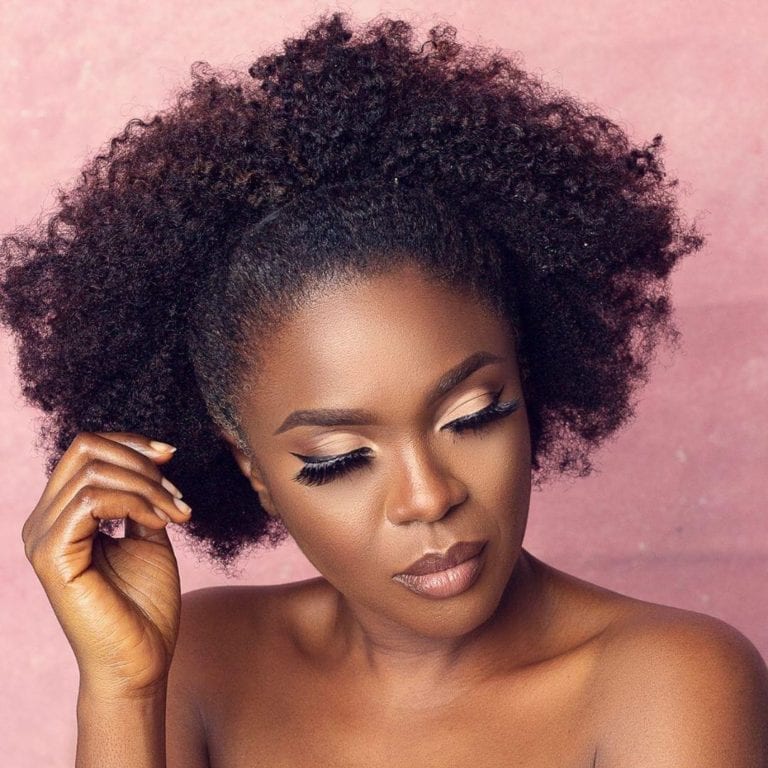
Oh mama! I love how healthy this hair looks.
So, I love black a lot. I have very dark hair and I’m often partial about this shade of hair on brownskin girls. It’s a match made in heaven, brought to you on today’s episode of celebrity trend-spotter by Omoni.
I know Omoni’s hairline is genetic and a lot of women put in the time but their hair won’t budge and it hurts.
Here’s a tip. Let go of risky hairstyles. It’s so annoying but I see this all the time especially in Lagos. This tribe whom I shall not name often take the most risk with hairstyles that damage their hairline yet they never learn. Honey, you’re hurting your hair.
If you have bad or damaged hair cut it and start all over. I used to keep a perm but I stopped because I found my hair was too tender for these products. No I don’t use cheap relaxers. My hair thins out and the colour isn’t as sexy as when it’s natural. However, you don’t have to keep an Afro to fit a stereotype or keep with trend.
When it comes to style, the rule is simple; find what fits you.
3. Busola Dakolo
This leads me to our third celebrity on today’s spotlight.
Source: Instagram
I just have to state it. Busola wig game is it!
Wig is all the trend now. Weaves, braids, everything just fits when Busola rocks it. So not fair! Fake sobs.
Anyway, she’s got the hair and we can’t help but turn the lights on her every day, every time.
4. Nengi Rebecca Hampson
Source: Instagram
How can a name be a mouthful and still be delectable. So not fair.
So bad I couldn’t find a better view on Instagram but if you watched Big Brother Nigeria, you’d know this: You can’t hate on that volume.
5. Zainab Balogun
Zai, I have to call you like we besties even though I only know you off of my screen. Girl! What! From low cut to a lush mane. How did you do it?
Now, this is personal, I started growing my hair a year before Zai (I’m getting used to calling her Zai) and my hair is nowhere near her length. Why? Where did I go wrong? Loud sobs. Snort. I’m a mess.
One day I’ll save enough to stop by Wash and Go and just have them love up on my hair.
Generally, women pay more attention to their hair because society favours women when it comes to nurturing and styling their hair in patterns and colours. This type of thinking puts a stomp in men’s hair care. I’m digressing.
Today’s men trend-spotter highlights five Nigerian celebrities with sexy hairstyles. Okay, sexy is a bit of a stretch but I have to admit they must be getting something right.
At least they’re stepping up their game.
I’ve tagged along to a couple of saloons to know that when it comes to hair, the majority of Nigerian men do the least. At most, they get a blowout or black hair dye to cover damages from cheap relaxers and washing repeatedly with bath soap.
Which is why today’s trend-spotter is throwing the spotlight on men that put an effort in hair care.
Let’s take a look at these men and their hair game.
Fair warning, these list was sorted in order of styles and may not highlight your fave.
1. Dread
Spotlight Dadaboyehiz and Sir Uti.
Dadaboyehiz Source: IGSirUti Source: IG
Dreads are not easy to keep. It requires effort and dedication. Plus, it’s one major hair trend that preserves the beauty of the African 4C hair. It’s also risky because of the harassment that young men face. Aside from that, a well-maintained dread is a gorgeous beauty all day every day. Dreads are versatile. You could go for the Bob Marley look or jazz it up like Uti. throw in a bit of colour, choke us with styles. You could tint it, fade the edges. Whatever.
2. Punk
This style is super popular as it tends to fit a lot of young men. It can pass as stylish but not crazy and suits all occasions slash outfit. perfect for nine to fivers.
Our spotlight is on Ebuka. I wonder if he ever has a bad hair day. Hmm.
Note. This post is not about trends in hair cuts but about maintaining texture and general beauty. It’s not enough to simply toss Apple hair food over your hair after a quick shower with premier cool.
Sobs loudly.
I love your hair. Your nappy hair deserves love. Just stop that bad habit.
Ebuka Source: IGMawuli Source: IG
3. Tint
Now that’s points for risk. To a large extent, artists seem to be the only ones brave enough to embrace coloured hair. I can’t blame the nine to five-ers most corporate environment seem to frown on edgy hairstyles.
There are creative ways to colour hair and I think we’ve played in this safe black hair space for far too long. You don’t have to do a full colour nor do you have to go neon overnight. If women can wear highlights so can anyone else.
Just make an effort. I’m tired of generic hairstyles.
Although I have to say that when it comes to healthy hair, Cracker is one of the favoured ones. Rough or tumbled, he’ll still look hot.
Cracker Malo
4. Skin Cut
Skin-cut is bold always a bold choice. I like it. I don’t know if any other race can pull a bald look like black men. Top that with a full lush beard. OMG! I can’t stop awing at the hairstyle. It’s not for everyone but it sure looks good. Top that with toned, well groomed beard. I have to stop while I’m at it. I’m getting carried away. If i were a guy this would be so difficult to maintain because my hair grows darn fast! i’ll to shave everyday and i don’t have that level of dedication.
Banky W Source: IG
5. Low Cut
I know not everyone can take risk with hairstyles. if you’re one of them, there’s no need to feel bad. You can be like Etim Effiong. What can I say, sometimes, less is more.
Etim Effiong Source: IG
Let’s face it, men’s hair fashion seems like a limited market. Most men don’t even have routine hair care other than that one visit to the barber on Friday evening so they look sharp for Saturday owambe. On other days, they slap on good old soul mate and comb.
What if style in men’s hair trend is limited because the solution is just rigorous.
What Does It Take to Slay to as a Nigerian Man?
Some hit the jackpot on the genetic pool but like women, some men struggle with coarse hair, chemically damaged hair, dandruff, split ends and tight curls.
They don’t talk about it enough but we know. Men also have a variety of hair textures and needs. This is one market yet to be explored. Are you thinking what I’m thinking?
As a man your hair doesn’t have to be boring WHEN TOUCHED.
EMPHASIS ON TEXTURE. Yes I am screaming.
If you are a lady reading this, you can share it with your brothers and lovers. Heck, get them some hair products. Please. Korean and American men get it. Even Mexicans get it. I see them every day on Brad Mondo’s.
Push the boundary. Redefine your style.
I get that most men do the lazy old fashioned low cut to look presentable to prospective in-laws. yawns. Well, how’s that working out for you? Are you now married? (I’m laughing hard, forgive me but it had to be said).
Five Tips on Maintaining Healthy Hair
I love good hair and I keep mine natural. Yes, I spend a good time grooming my hair and trying all types of things on it because I find the process quite rewarding. However, I’m keeping the tip simply because I’m writing for men.
Get a shampoo
Use conditioners after washing
Use a leave-in conditioner daily
Eat Healthily
Try Highlights that soothe your tone.
This is the most minimal routine. AVOID WASHING YOUR HAIR WITH BATH SOAP. The cheapest saloon shampoo will do just fine. I also recommend black soap (For best result, dissolve in water).
I recommend Ossat rinse out and leave-in conditioner.
More often when we talk about men’s hair, we focus more on haircuts and barbershop razor stunts. On behalf of all Nigerian women, I plead with men to put the E in the effort. I don’t make a lot of fuzz when a guy has a new haircut. I’m more of a texture gal.
I know I threw a few stones but I hope you found it helpful. Go have fun with your hair. Whatever happens, don’t be this guy.